Why Use a Hardening Oven for Industrial Heat Treatment?
Industrial manufacturers rarely have room for uneven hardness, distorted parts, or repeated rework. A Hardening Oven provides controlled heating, soaking, and cooling for steel components, gears, shafts, tools, and wear-resistant assemblies. Its value is practical. Stable chamber temperatures protect batch consistency, while programmable recipes help operators repeat verified results.
The International Energy Agency’s Energy Technology Perspectives 2024 identifies industrial process heat as a major challenge for energy efficiency and emissions reduction. That concern reaches heat treatment directly. An inefficient oven can waste energy through poor insulation, excessive door opening, weak airflow, or unnecessary over-soaking. The U.S. Department of Energy’s Industrial Decarbonization Roadmap also highlights energy efficiency, electrification, and improved process control as important industrial priorities. These reports support a clear point: oven performance affects both production quality and operating cost.
Dr. George E. Totten, editor of Steel Heat Treatment: Metallurgy and Technologies, describes heat treatment as “the controlled heating and cooling of metals.” That control is the heart of a Hardening Oven. Yet equipment alone cannot guarantee success. Load spacing, thermocouple placement, quench timing, and operator discipline still matter. Small details matter.
A clean, calibrated oven may produce bright, uniform parts. A poorly maintained one may leave soft edges or visible discoloration. The uncomfortable truth is that many failures begin before the cycle starts. Therefore, selecting a Hardening Oven requires more than reviewing maximum temperature. Manufacturers should examine temperature uniformity, atmosphere control, energy consumption, maintenance access, validation records, and compliance with relevant standards, including AMS2750 and CQI-9 where applicable.
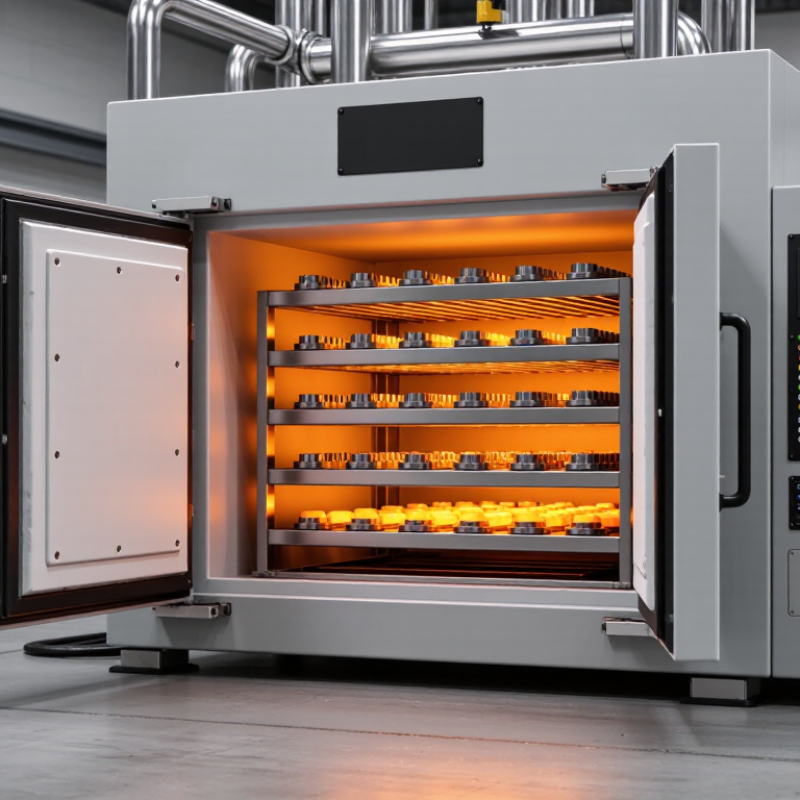
What Is a Hardening Oven in Industrial Heat Treatment?
A hardening oven is an industrial furnace used to heat metal parts to a controlled hardening temperature. For steel, this temperature often exceeds the material’s critical transformation range. The oven holds the load there long enough for heat to reach the core. This stage is called soaking. It prepares the structure for rapid cooling in oil, water, polymer, or another approved quenching medium.
Temperature control is the oven’s essential function. Accurate thermocouples, stable airflow, and even load spacing help prevent soft spots and uneven hardness. A typical batch may contain gears, shafts, or machined plates arranged on trays. Parts must not touch unnecessarily. Crowded loads can trap cooler zones. Small errors matter.
Hardening is not simply “heat and cool.” Operators must confirm the steel grade, furnace recipe, transfer time, and quench condition. Records support repeatable production and help identify failures. Even with careful control, distortion and residual stress may appear. That is why many components require tempering after quenching. The process is powerful, but not perfect. A recipe that works for one thickness may fail on another. Regular calibration and practical inspection remain necessary.
Why Use a Hardening Oven for Industrial Heat Treatment? - What Is a Hardening Oven in Industrial Heat Treatment?
| Data Dimension | Typical Industrial Data | Relevance to Hardening and Heat Treatment |
|---|---|---|
| Equipment definition | An insulated, temperature-controlled industrial furnace used to austenitize steel before quenching. | It provides controlled and repeatable heating so the workpiece can develop the required metallurgical structure before rapid cooling. |
| Typical operating temperature | Approximately 750–1,100°C (1,382–2,012°F), depending on steel grade and process design. | Carbon and alloy steels require different austenitizing temperatures. The exact setpoint must follow the material specification or approved heat-treatment procedure. |
| Temperature uniformity | Common production targets are within approximately ±5–10°C after stabilization; the actual value depends on furnace design and qualification. | Uniform heating helps reduce soft spots, excessive grain growth, distortion, and inconsistent hardness across the load. |
| Heating method | Electric resistance heating or fuel-fired heating with forced air circulation. | Controlled circulation improves heat transfer and reduces temperature differences between the load surface and core. |
| Atmosphere control | Air atmosphere for general work, or protective gas, vacuum, or controlled-atmosphere processing for oxidation-sensitive parts. | Atmosphere control can limit scale, decarburization, and surface contamination, reducing post-treatment cleaning or machining. |
| Required soaking time | Determined by steel grade, section thickness, load arrangement, furnace circulation, and the time needed for the workpiece core to reach temperature. | Adequate soaking promotes a more consistent austenitic structure; excessive soaking can increase grain growth and distortion risk. |
| Quenching compatibility | Compatible with oil, water, polymer solution, gas, or salt quenching systems, depending on the production line. | The oven must support safe transfer from the heating chamber to the selected quench medium while minimizing delay and heat loss. |
| Hardness outcome | Hardness depends on steel chemistry, austenitizing conditions, quench severity, section size, and subsequent tempering. | The oven establishes the heating stage; it does not independently determine final hardness without a controlled quench and, where required, tempering process. |
| Process repeatability | Recipe-based control can record setpoint, ramp rate, soak time, atmosphere, and alarm events for each batch. | Repeatable recipes improve batch-to-batch consistency and make process verification easier. |
| Typical applications | Gears, shafts, fasteners, dies, cutting tools, bearings, automotive parts, and general machine components. | Hardening increases wear resistance and strength, while the final properties must be matched to the component’s service requirements. |
| Energy efficiency factors | Insulation quality, door sealing, load utilization, air circulation, heating control, maintenance, and recovery time. | Efficient operation lowers heat loss and operating cost without sacrificing temperature control or metallurgical quality. |
| Safety provisions | Over-temperature protection, door interlocks, emergency shutdown, insulation, ventilation, and quench-area safeguards. | These features help protect operators and equipment from high-temperature surfaces, uncontrolled heating, fumes, and quench-related hazards. |
| Quality verification | Temperature surveys, calibrated sensors, hardness testing, visual inspection, and metallographic examination when required. | Verification confirms that the furnace and the complete heat-treatment cycle meet the applicable production and material requirements. |
Note: Values shown are typical industrial ranges or process descriptions. Actual settings should be established from the applicable steel grade, component geometry, furnace qualification, and approved heat-treatment specification.