Why Choose Injection Molding Automation?
Why choose Injection Molding Automation? The answer often begins at the press: a robot removes a hot part, a conveyor carries it onward, and an operator no longer repeats the same handling motion every cycle. Done well, automation can improve consistency, reduce manual handling, and keep production moving through breaks and shift changes. The details matter. A poorly tuned process does not become reliable just because a robot is added.
The International Federation of Robotics’ World Robotics 2024 report counted 4,281,585 industrial robots operating worldwide in 2023, a 10% increase from the previous year. That figure covers many industries, not injection molding alone. Still, it shows how widely manufacturers are adopting automation. For molding teams, the practical case is more specific: cycle-time stability, repeatable part removal, and fewer missed handoffs between machines.
John Bozzelli, an injection-molding consultant known for his work on process control, offers a useful principle when his guidance is paraphrased: stabilize the molding process before automating it. That distinction is easy to overlook. Automation can expose a weak setup as quickly as it can improve a sound one. Not every press needs a fully automated cell. A takeout robot, a simple conveyor, or carefully planned part inspection may be the better first step. Start with the bottleneck. Then measure what changes. The payback depends on real production conditions, including staffing, maintenance, part design, and downtime—not a sales promise.
What Injection Molding Automation Includes
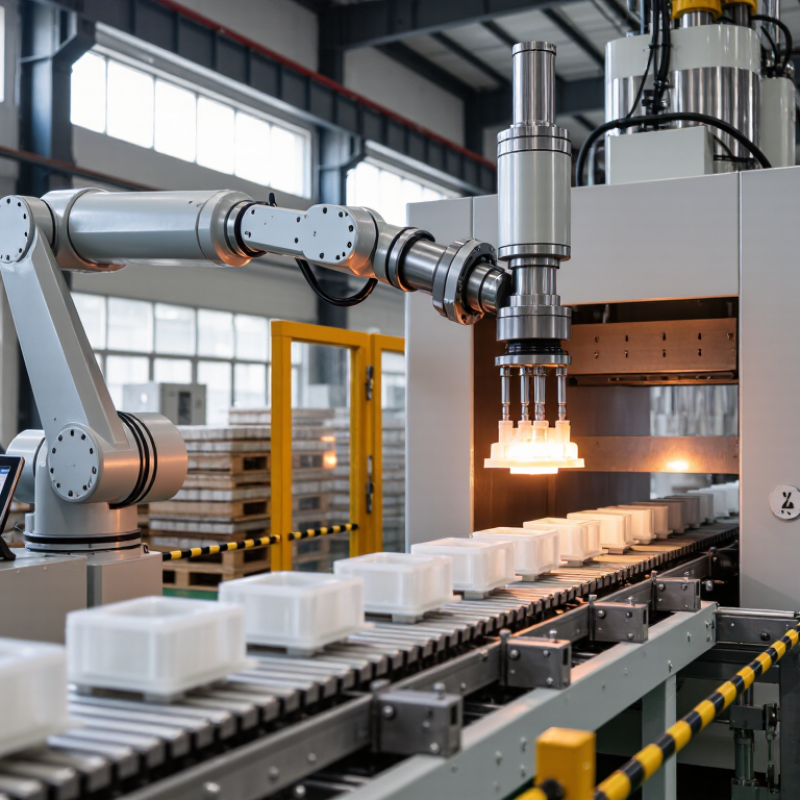
Injection molding automation covers more than a robot removing finished parts. It can include part takeout, sprue separation, conveyor transfer, and placement into trays or packaging. A robot may use a simple grip for rigid parts or a softer end effector for delicate components. The right choice depends on part shape, cooling time, and how much handling the surface can tolerate.
Automation can also feed inserts, monitor process signals, and route parts for inspection. Vision systems may check for missing features or visible defects, while sensors track door status and equipment conditions. These tools support consistent production, but they do not replace process knowledge. A camera can miss a subtle flaw if lighting or inspection criteria are poorly set. That happens. Operators still need clear procedures and time to verify results.
A practical setup often links the molding machine, robot, conveyor, and safety controls through a coordinated cell. For example, a robot can remove a warm part, place it on a belt, and keep the mold area clear for the next cycle. Data logging can help teams spot cycle-time drift or repeated stoppages. Yet every added device brings setup and maintenance needs. Changeovers may also take longer than expected, especially when products use different grippers or tray layouts. Teams should test those details with real parts before relying on the cell for routine output.

How Automation Fits Into the Molding Process
Injection molding automation can begin before the mold closes. A dryer removes moisture from resin, while a controlled conveying system delivers pellets to the machine. During each cycle, sensors track conditions such as temperature and pressure. These readings help operators spot drift before it causes a larger run of defects.
When the mold opens, a robot can remove the part and place it on a conveyor or inspection fixture. End-of-arm tooling must match the part’s shape and release points; a poor fit can leave marks or slow the cycle. Trimming, sorting, and packing may also be automated, but each added step needs room, safe access, and reliable timing. Small details matter.
Automation works best when it supports a stable molding process, not when it is expected to repair one. A robot can repeat a motion precisely, but it cannot correct inconsistent resin drying or an improperly tuned process. In practice, a cell may need adjustments after the first trials: parts can cool differently, or a gripper may flex under load. That is normal, though it deserves attention. Teams should test the whole sequence, measure cycle time, and check part quality before increasing production.
Why Choose Injection Molding Automation? - How Automation Fits Into the Molding Process
| Molding Process Stage | Typical Manual Task | Common Automation Application | How It Can Help | Important Consideration |
|---|---|---|---|---|
| Material handling | Moving resin, loading material, and monitoring supply to the molding machine. | Vacuum conveying, centralized material systems, and automated drying and feeding. | Can provide a more consistent material supply and reduce routine handling. | Material drying and handling requirements depend on the resin and must follow its processing guidance. |
| Mold setup and changeover | Connecting utilities, installing the mold, and entering process settings. | Quick mold-change equipment, automated clamp systems, and stored machine recipes. | Can make repeat changeovers more organized and reduce some setup steps. | Recipes and connections still need verification for the specific mold, machine, and material. |
| Part removal | Removing molded parts from the mold area after each cycle. | Robots or sprue pickers remove parts or runners from the mold. | Can support repeatable removal and keep operators away from the mold area during automatic operation. | Robot reach, end-of-arm tooling, cycle timing, and machine safety interlocks must be properly engineered. |
| In-cycle inspection | Checking parts at intervals for visible defects or dimensional concerns. | Vision systems, sensors, or gauging equipment inspect selected part features. | Can identify certain detectable conditions consistently and flag parts for review or rejection. | Inspection capability depends on lighting, part presentation, measurement method, and validated acceptance criteria. |
| Secondary operations | Trimming, inserting components, labeling, or assembling molded parts. | Robotic cells, fixtures, and automated stations perform suitable downstream tasks. | Can connect molding with finishing steps and reduce repetitive part transfers. | Part variation and task complexity determine whether automation is practical and reliable. |
| Packaging and production records | Counting parts, packing them, and recording production information. | Automated counting, conveyors, packaging equipment, and machine-data collection. | Can help standardize counts and make production information easier to capture. | Data systems need clear definitions, accurate sensors, and appropriate review procedures. |
Note: Automation options and results vary with part design, material, mold, production volume, and required inspection standards. Appropriate guarding, risk assessment, and operator training remain essential.
Operational Benefits of Automating Production
Automating injection molding can reduce repetitive work around the press and make production more consistent. A take-out robot can remove each part at a steady point in the cycle, while a conveyor moves it to inspection or packing. Operators spend less time reaching into busy work areas and more time checking process conditions. Small gains matter.
Automation also helps control routine steps. Sensors can flag missing parts, misaligned inserts, or irregular cycle times before a full batch is affected. When drying, material feeding, and part handling are coordinated, fewer interruptions occur between cycles. Production records can reveal recurring delays, though the data is useful only when someone reviews it and acts.
The benefits depend on the job. A cell designed for one stable product may be awkward during frequent mold changes or short runs. Grippers need careful testing, and even a reliable robot cannot correct poor molding settings. A poorly planned layout can shift bottlenecks from the press to inspection or packaging. That trade-off deserves an honest review before equipment is selected.
Key Factors for Choosing an Automation System
Why Choose Injection Molding Automation?
Key Factors for Choosing an Automation System
Choosing an automation system starts with the molding cell, not a catalog. Check press size, tie-bar spacing, mold opening, and available floor space. A robot that clears the mold but blocks an operator’s route is not a good fit. Measure cycle times across different shifts; ideal figures can be misleading. Small details matter. Define the tasks clearly: part removal, sprue separation, inspection, or box loading. Not every process needs every feature.
Consider how often molds and products change. A fixed setup may suit steady, high-volume work, while quick-change grippers can help with mixed production. Ask to see a representative part handled at production speed, including a restart after a fault. Watch for scratches, dropped parts, and awkward reach points. Safety functions, guarding, and clear recovery steps deserve review by operators and maintenance staff. Training and technical support affect uptime as much as hardware. Calculate costs using labor, scrap, downtime, and integration—not purchase price alone. The estimate will still be imperfect. Leave room for future changes, but avoid paying for capacity with no clear use.
Why Choose Injection Molding Automation?
Key factors for choosing an automation system
The chart shows an illustrative plant-level assessment, not an industry survey: factors are scored from 1 (lower priority) to 5 (higher priority). Evaluate cycle-time fit, part handling, machine compatibility, safety, changeover needs, and integration against your own production requirements before selecting a system.
Where Injection Molding Automation Is Most Useful
Injection molding automation is most useful when a process repeats the same actions throughout a long production run. Robots can remove hot parts, place them onto a conveyor, and keep cycle timing consistent. This reduces manual handling near the press and helps prevent parts from piling up. Small details matter. A gripper must hold the part without marking its surface.
Automation also suits insert molding and jobs with several downstream steps. A robot can position a metal insert, transfer the molded part, and present it for inspection. A camera may check for missing features or visible flash before parts reach a packing station. These checks work best when lighting and part presentation stay consistent. Otherwise, the system may reject good parts—or miss defects.
High output alone is not a reason to automate. Frequent mold changes, short runs, or parts that vary widely may make a flexible manual setup more practical. Not every cell needs a robot. Before investing, teams should compare cycle time, changeover effort, quality records, and operator tasks. A poorly arranged process can simply become a faster, more complicated problem. That is easy to overlook when the equipment looks impressive.