Why Choose a Sandwich Cake Machine for Your Bakery?
A bakery’s sandwich cakes can look simple in the display case: soft sponge, even cream, clean layers, and a neat finish. Producing that same result during a busy shift is harder. A Sandwich Cake Machine can help standardize filling, stacking, and portioning, depending on its design and setup. That matters when staff must prepare several trays while keeping the counter stocked.
The market is substantial. Grand View Research estimated the global bakery products market at USD 480.7 billion in 2023 and projected a 6.7% compound annual growth rate from 2024 to 2030. This figure describes the wider bakery category, not demand for sandwich cakes or equipment specifically. It offers context, not a sales guarantee. Small distinction. Still important.
For bakery owners, the practical question is whether a machine fits the product range, daily volume, and available workspace. Look closely at changeover time, portion consistency, cleaning access, and how the equipment handles delicate sponge and soft fillings. A machine may reduce repetitive handwork, but it will not fix poor recipes or uneven ingredients. That part is easy to overlook. Ask suppliers for product trials using your own cake layers, and compare usable output with labor, waste, and maintenance costs. The right choice should make production steadier without making a small bakery less flexible. It may take honest testing to find that balance.
What a Sandwich Cake Machine Is and How It Works
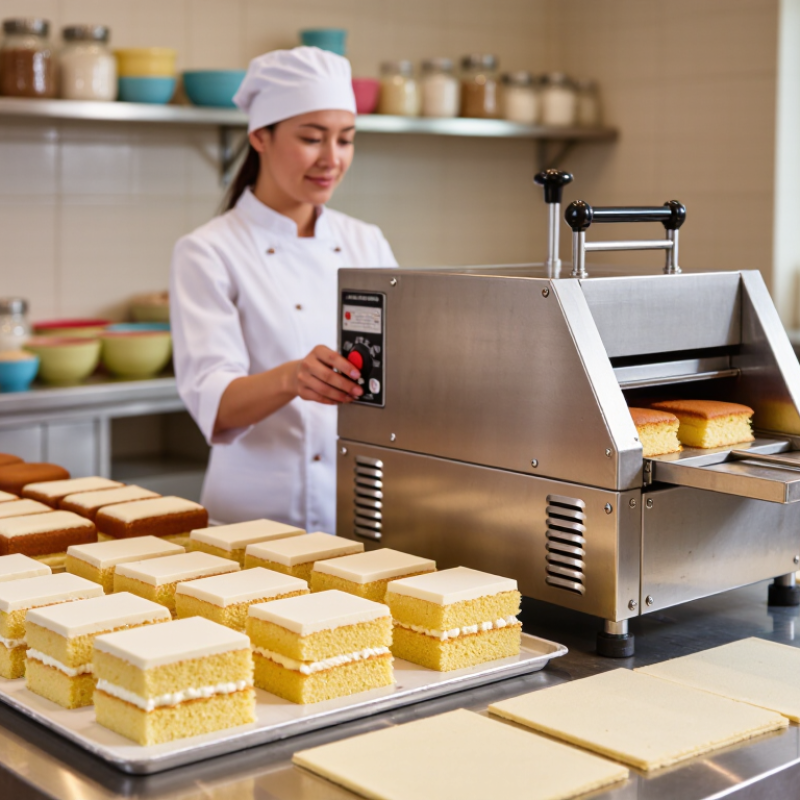
A sandwich cake machine assembles sponge layers with a measured filling between them. Depending on its design, it may align cake sheets, deposit cream or jam, stack layers, and guide the finished cake onward for cutting or finishing. Some models handle only one task; others combine several stations. The machine’s purpose is repeatable placement, not inventing a better recipe.
A conveyor moves each layer beneath a hopper or dosing nozzle. The filling amount is adjusted to suit its thickness and flow, while guides help keep the cake centered. A stacking unit then places another layer on top, with pressure set gently enough to avoid squeezing filling out at the edges. Small details matter. A cream that is too warm may spread unevenly, while a dry sponge can crack under excess pressure.
Operators usually test settings with the actual cake and filling before production. They check layer alignment, portion weight, and the cut surface, then make small adjustments. It is not entirely automatic; that part is easy to underestimate. Cleaning access, changeover time, and the machine’s compatible cake sizes also deserve attention. Follow the equipment manual for setup and sanitation, and record settings that produce consistent results.

How It Fits a Bakery’s Production Needs
A sandwich cake machine can make layered production more predictable when orders grow beyond what a small team can assemble by hand. It can deposit filling between sponge layers at a steadier rate, helping cakes keep a more even profile. That matters. A level filling layer can reduce leaning during chilling and make portions easier to cut.
The right setup depends on the bakery’s products and daily volume. A bakery making a few custom cakes may value adjustable settings and quick changeovers more than maximum speed. A larger team producing the same cake all morning may benefit from a feed system that keeps layers moving without frequent manual handling. Operators still need to check cake thickness, filling temperature, and alignment. Small differences show.
Cleaning and recipe changes also shape real output. A machine that is difficult to disassemble may save time during production but add work at the end of a shift. Ask staff to trial the equipment with the bakery’s actual sponge and filling, not just a sample recipe. Record cakes per hour, rejected pieces, setup time, and cleaning time. The numbers may disappoint at first. That is useful information. A machine should fit the workflow the bakery has, while leaving room for its products and order patterns to change.
Why Choose a Sandwich Cake Machine for Your Bakery?
How It Fits a Bakery’s Production Needs
This example shows the layer counts in simple sandwich cakes: each filling layer sits between two sponge layers. A sandwich cake machine can help repeat filling and layering steps more consistently; actual capabilities vary by machine and product.
Key Benefits for Consistency, Speed, and Labor
In a busy bakery, sandwich cakes can be difficult to assemble evenly by hand. A sandwich cake machine helps control how batter or filling is distributed across each layer, depending on its design. The result is more consistent thickness and fewer lopsided cakes on the display counter. That matters. Even layers also make portions easier to cut and decorate.
During a rush, the machine can handle repetitive spreading or layering while staff prepare pans, check baking times, or finish orders. This can shorten routine production and reduce hand fatigue. It does not remove the need for skilled bakers. Someone still needs to load ingredients, monitor the process, and inspect the cake before it moves to the next step. Not perfectly, though. Batter temperature, recipe changes, and incorrect settings can affect the result.
Labor savings come from using staff time differently, not simply removing people from the workflow. A new operator may need practice to set the machine and clean it thoroughly between batches. Small test runs help reveal uneven filling or alignment problems before a full production shift. For bakeries making similar cakes throughout the day, that learning curve may be worthwhile; for highly varied, small-batch work, manual assembly can remain more flexible.
Machine Types and Features to Compare
When comparing sandwich cake machines, start with the filling method. Depositor-style machines apply cream or jam between cake layers; spreading systems suit softer fillings and smaller batches. For a bakery making several sizes, check adjustable guides, layer thickness control, and changeover time. A neat cut matters: uneven filling can squeeze out when the cake is sliced.
Capacity is not just cakes per hour. Compare the machine’s feed style, portion accuracy, cleaning access, and ability to handle delicate sponge without crushing it.
BLS projects 5% employment growth for bakers from 2023 to 2033, with about 31,400 openings each year. That labor outlook makes repeatable portioning worth assessing, though automation will not fix poor cake preparation. (U.S. Bureau of Labor Statistics, Occupational Outlook Handbook: Bakers, 2024.)
Ask for a trial using your own sponge and filling. Watch the first and last cakes in a run. Small details show up there. A machine that is fast on paper may still create waste if operators struggle to adjust it.
How to Choose a Machine for Your Bakery
Choosing a sandwich cake machine starts with the cakes you actually sell. List their diameters, sponge thicknesses, and filling styles. A soft cream layer needs different pressure from a firm fruit filling. Ask whether the machine handles your usual sizes without trimming or awkward adjustments. Test real cake layers, not just an empty cycle. Small differences matter.
Match capacity to your busiest hours, not an optimistic sales forecast. Check the machine’s output per hour, then compare it with staff preparation and decorating time. A fast depositor can still create a bottleneck if trays pile up nearby. Watch a full production run. Test it in person. See whether portions stay even across several cakes, including the last one in the batch. Speed is tempting, but it can be the wrong measure.
Cleaning and setup deserve equal attention. Look for removable food-contact parts, accessible corners, and clear instructions for daily washdown. Measure the machine beside your worktable, and confirm that power and ventilation suit the space. Ask about operator training, spare parts, and service response times. There is no perfect setting. A compact model may save room but require more frequent loading, and I would weigh that trade-off against the bakery’s actual workflow. Request a demonstration with your ingredients before committing.
| Selection Factor | What to Evaluate | Practical Guidance | Why It Matters |
|---|---|---|---|
| Daily production volume | Typical cakes or assembled units required per shift | Estimate demand during an ordinary day and peak periods. Ask suppliers for a demonstration using your product and production speed. | A machine sized for actual demand can reduce repetitive manual work without adding unnecessary capacity or cost. |
| Machine configuration | Manual, semi-automatic, or automatic operation | Manual equipment suits small batches; semi-automatic systems combine operator loading with powered depositing or assembly; automatic lines are designed for more continuous production. | The right level of automation depends on labor availability, batch size, and how consistent your production schedule is. |
| Cake size and format | Layer diameter, shape, height, and product range | Check the specified size range and changeover requirements. Confirm whether the machine handles round, rectangular, or multiple product formats. | Compatibility helps avoid uneven filling, product damage, or frequent manual adjustments. |
| Filling type and control | Filling viscosity, portion size, and deposition accuracy | Test the machine with your actual cream, jam, or other filling. Review portion adjustment, repeatability, and how easily the filling system can be cleaned. | Consistent filling supports uniform products and helps manage ingredient use. |
| Changeover and flexibility | Time and effort required to switch products | Ask how settings, nozzles, guides, and contact parts are changed. Check whether common product changes can be completed with basic tools. | Quick, straightforward changeovers are useful for bakeries producing several recipes or sizes. |
| Cleaning and food safety | Access to food-contact parts and cleaning procedure | Look for removable or accessible contact components, smooth surfaces, and a documented cleaning process. Confirm materials are suitable for food-contact use. | Effective cleaning supports hygienic production and can reduce downtime between batches. |
| Footprint and utilities | Available floor space, power supply, and any required air supply | Compare the machine’s installed dimensions with your layout, including operator access and cleaning clearance. Verify electrical and pneumatic requirements before purchase. | Checking site requirements early helps prevent installation delays and workflow problems. |
| Operator training and safety | Controls, guarding, emergency stops, and training support | Review operating instructions, safety features, and training arrangements. Make sure operators can reach controls and perform routine tasks safely. | Clear procedures and suitable safeguards support consistent operation and safer work. |
| Service and total cost | Maintenance, spare parts, warranty, and operating costs | Request details on routine maintenance, parts availability, service response, warranty coverage, and installation costs. | The purchase price alone does not show the full cost of owning and operating the machine. |
| Before making a decision | Prepare a short list of your cake sizes, filling types, expected output, available space, and cleaning requirements. Compare machines against these needs and verify all capacity and utility specifications directly with the supplier. | ||