Top 10 Ultra High Temperature Servo Motor Manufacturers
Electric motors account for an estimated 45% of global electricity use, according to the International Energy Agency’s 2011 report, Energy-Efficiency Policy Opportunities for Electric Motor-Driven Systems. That figure covers motors broadly, not servo motors or high-temperature applications alone. Still, it shows why efficiency and dependable operation matter.
An Ultra High Temperature Servo Motor must do more than survive hot air. Its windings, insulation, bearings, encoder, cables, and feedback system all face heat-related limits. Picture a motor operating beside a furnace: ambient heat rises, cooling becomes harder, and a small change in sensor performance can affect positioning. A catalogue temperature rating is useful, but it does not replace application-specific testing.
This guide compares ten manufacturers through practical criteria: published temperature limits, torque and speed data, feedback options, cooling methods, certifications, and evidence of testing. Buyers should check whether a stated limit applies to continuous operation, short-duration exposure, or a specific motor configuration. These details are easy to overlook.
The supplied material does not identify a verifiable industry expert or provide an attributable quotation. Rather than invent one, this introduction avoids assigning a statement to a named person. The same caution applies to market estimates: broad motor-industry figures should not be presented as data for this specialized product category. A useful comparison begins with evidence, and some product claims deserve closer scrutiny.
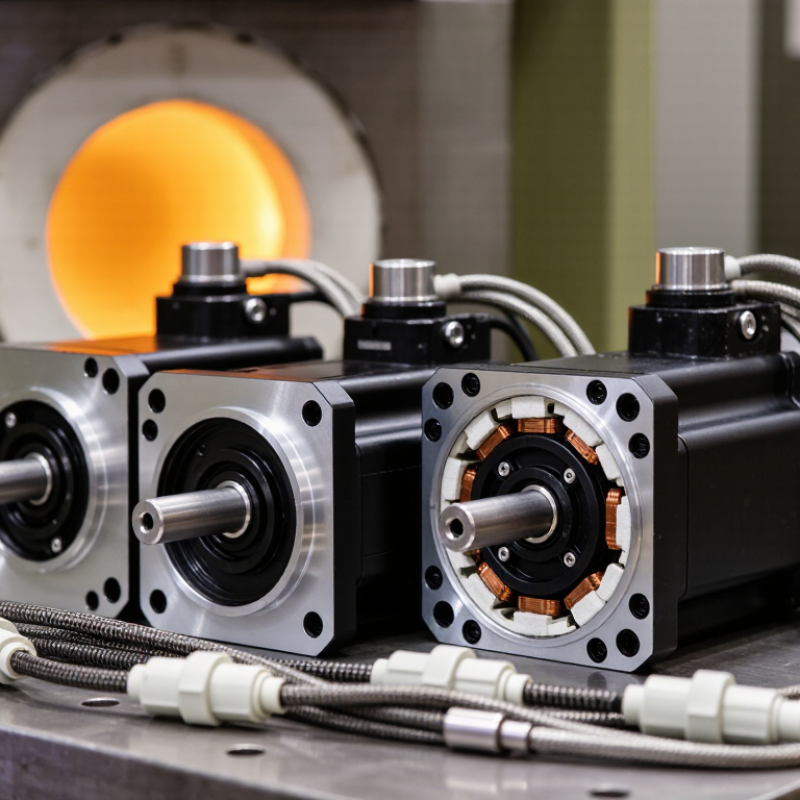
Defining Ultra-High-Temperature Servo Motors and Their Operating Limits
An ultra-high-temperature servo motor is designed to maintain controlled motion where heat exceeds the range of ordinary industrial service. The label is not a universal temperature class. A motor may tolerate a hot ambient environment only with reduced torque, limited operating time, or additional cooling. The winding, insulation, permanent magnets, bearings, encoder, and cable each have different thermal limits. One weak component can set the practical limit. Heat also builds inside the housing during repeated acceleration, even when the surrounding air seems manageable.
Operating limits should therefore be checked against the full duty cycle, not a single temperature rating. Engineers consider ambient heat, load, speed, mounting, airflow, and exposure duration. A sensor near the motor case helps, but it may not reveal winding hot spots. Some systems need thermal models or winding sensors. Small details matter. For example, grease can thin, seals can harden, and feedback accuracy can drift as temperatures rise. Test the actual assembly under realistic loads, then apply a safety margin. Ratings are useful, but they are not guarantees. In practice, I would treat any unverified limit as provisional; that caution can be inconvenient, yet a brief bench test may miss slow heat accumulation.
Thermal Benchmark: IEC 60085 Class H Insulation Is Rated at 180°C
IEC 60085 places Class H insulation in the 180°C thermal class. That figure describes the insulation system’s thermal classification; it is not a promise that a servo motor can run continuously at 180°C. IEC 60034-1 also treats motor ratings and temperature rise as design conditions, so cooling, load, and measurement method matter. A hot spot inside a compact motor can exceed the temperature measured at its casing.
When comparing ultra-high-temperature servo motors, check the stated winding-temperature limit, duty cycle, cooling method, and test conditions. Ask whether the 180°C claim applies to the insulation system or to continuous operation under a specified load. A motor beside a hot furnace may face radiant heat, dust, and repeated acceleration; those stresses can shorten insulation life even when the headline temperature sounds adequate. Standards offer a useful baseline, not a substitute for application data.
Tips: Request the IEC 60085 insulation class and IEC 60034-1 test details. Compare winding and ambient limits separately. If the supplier gives only one temperature number, ask what was measured and where. Small detail, big difference.
How to Compare Manufacturers: Torque, Speed, Cooling, and Protection
Selecting an ultra-high-temperature servo motor starts with the real load, not catalog peak torque. Measure continuous and peak shaft torque, including acceleration, friction, and payload inertia. A brief peak rating cannot replace continuous-duty data. Compare torque-speed curves at your operating voltage; available torque often drops as speed rises. Check encoder feedback and overspeed limits, too. A warm gearbox can change the result.
The U.S. Department of Energy’s Improving Motor and Drive System Performance sourcebook estimates that motor-driven systems use about 69% of U.S. industrial electricity. Efficiency matters, but thermal margin matters more here. IEC 60085 sets thermal classes F and H at 155°C and 180°C; these are insulation-system limits, not permissible ambient temperatures. Ask for winding, bearing, and magnet limits under stated loads. Compare conduction, forced-air, or liquid cooling using test conditions that match your mounting and coolant. IEC 60034-5 defines IP enclosure ratings, but a high IP rating does not prove heat endurance. Request temperature-rise curves, duty-cycle details, and an independent test report. Check cable seals and sensor placement. Spec sheets can be vague; I would not assume “high-temperature” means your cabinet stays safe.
Top 10 Ultra-High-Temperature Servo Motor Manufacturers and Their Strengths
The strongest ultra-high-temperature servo motor manufacturers stand out through engineering depth, not a headline temperature rating. Their designs may combine high-grade winding insulation, heat-resistant magnets, stable bearing systems, and carefully selected lubricants. These choices help preserve torque and positioning accuracy when a motor operates near a hot furnace or curing line. Details matter. A capable supplier also explains how ambient heat, load, speed, and cooling affect the rated operating range.
Among the top 10, strengths often differ. Some manufacturers excel at custom housings and compact drives; others offer strong thermal testing, encoder integration, or application support. Look for test data that reflects continuous operation, not only brief exposure. Ask how performance changes as temperature rises, and whether cables, seals, and feedback devices share the same rating. A specification sheet can still leave gaps. I would also check repair options and technical documentation before comparing prices.
Tips
Match the motor’s rated temperature to the actual mounting-point temperature, with a sensible margin. Request test conditions and duty-cycle details. If possible, trial the motor under real load; heat buildup can surprise you.
Industry Applications, Qualification Tests, and Service-Life Considerations
High-temperature servo motors work near ovens, furnaces, and thermal-processing lines, where radiant heat can reach connectors and feedback devices as well as the housing. The IEA’s 2011 report, Energy-Efficiency Policy Opportunities for Electric Motor-Driven Systems, estimates that motor-driven systems use about 45% of global electricity. That scale makes dependable performance more than a niche concern. IEC 60034-1 identifies insulation thermal classes including F at 155°C and H at 180°C; these figures describe insulation classes, not guaranteed ambient operating temperatures. Small details matter. A cable gland beside a hot enclosure may age sooner than the winding.
Qualification should reproduce the machine’s real duty cycle. Test plans commonly include thermal soak, repeated heat-and-cool cycles, insulation resistance, dielectric withstand, vibration, and torque checks at operating temperature. IEC 60034-18-41 provides guidance for qualification of partial-discharge-free insulation systems used with converter supplies. Record winding and bearing temperatures, load, speed, and cooling conditions; otherwise, a pass result is hard to compare. A tidy laboratory test can still be misleading.
Service life depends on the weakest heat-sensitive component, not just the motor insulation. Bearing lubricant, magnets, encoder electronics, seals, and cables each have their own temperature limits. Ask suppliers for measured temperature margins and endurance-test conditions, then compare those values with site data. The awkward truth: maintenance access is often planned late. A motor that survives heat but cannot be inspected easily may still disrupt production.