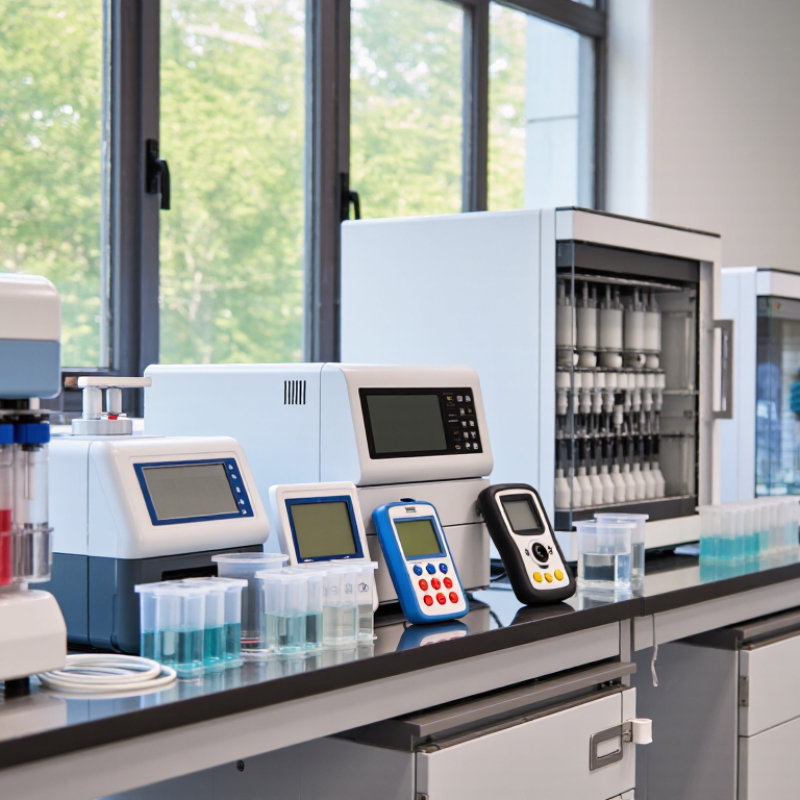
Top 10 Phosphate Analyzer Types for Global Buyers
Selecting the right Phosphate Analyzer can influence process control, compliance, and long-term operating costs. Global buyers often compare laboratory, portable, and online models before choosing equipment. Each type serves a different working environment. A wastewater plant may need continuous monitoring near a dosing point, while a research laboratory may require precise batch testing. Agricultural users often prioritize field portability, simple sampling, and fast results.
The top ten phosphate analyzer types in this guide reflect practical differences in measurement method, installation, sensitivity, and maintenance. Colorimetric analyzers remain popular because they provide familiar testing procedures and flexible detection ranges. Ion-selective systems can support rapid measurements, although sample conditions may affect accuracy. Automated flow analyzers suit laboratories handling many samples, while handheld photometers help technicians inspect water directly beside a tank or river. Small details matter, including reagent shelf life, tubing replacement, display readability, and calibration frequency.
Not every specification tells the full story. A low detection limit may become less useful when samples contain suspended solids, iron, or strong color. Buyers should review technical documentation, validation data, warranty terms, and regional service capabilities. Independent laboratory comparison is valuable, but field experience still exposes problems that brochures may overlook. We have seen efficient instruments perform poorly when operators skipped filtration or used expired reagents. That is an avoidable lesson. Reliable selection requires matching the Phosphate Analyzer to the sample matrix, testing volume, workplace conditions, and local expertise. This overview offers a practical starting point, not a universal ranking. Some purchasing decisions remain uncertain until real samples are tested.
Phosphate Analyzer Fundamentals and Measurement Principles
Top 10 Phosphate Analyzer Types for Global Buyers
Phosphate analyzers measure reactive phosphorus in water, wastewater, soil extracts, and process streams. The core principle is usually color development. Phosphate reacts with molybdate reagents, forming a blue or yellow compound. A photometer then measures absorbance at a defined wavelength. Higher absorbance normally indicates higher phosphate concentration.
The main analyzer types include molybdenum-blue, vanadomolybdate, enzymatic, ion-selective, flow-injection, segmented-flow, discrete, ultraviolet-visible, handheld, and online analyzers. Laboratory instruments often use Standard Methods 4500-P or U.S. EPA Method 365.1. These procedures emphasize digestion, calibration, reagent control, and interference management. Online systems require stable flow, automatic cleaning, and frequent verification.
Phosphate forms matter. Orthophosphate can be measured directly, while total phosphorus usually requires digestion first. Suspended solids may scatter light and create false readings. Silicate and arsenate can also interfere with some colorimetric methods. I have found that a clean sample line often matters as much as expensive optics.
UNESCO’s World Water Development Report 2017 stated that over 80% of global wastewater was discharged without treatment. This highlights the need for dependable phosphate monitoring. Still, no analyzer is perfect. A field result can change after filtration, preservation, or delayed testing. Buyers should compare detection limits, recovery results, maintenance intervals, and matrix-specific validation data, not only brochure accuracy.
Top 10 Phosphate Analyzer Types for Global Buyers - Phosphate Analyzer Fundamentals and Measurement Principles
A practical comparison of phosphate measurement technologies, typical operating ranges, sample requirements, and application considerations.
| Rank | Analyzer Type | Primary Measurement Principle | Typical Reported Result | Typical Working Range | Approximate Detection Capability | Suitable Sample Types | Typical Analysis Time | Main Advantages | Key Limitations | Common Buyer Applications |
|---|---|---|---|---|---|---|---|---|---|---|
| 1 | Molybdenum Blue Colorimetric Analyzer | Orthophosphate reacts with molybdate and a reducing agent to form a blue phosphomolybdenum complex. Absorbance is measured photometrically, commonly near 660–880 nm depending on the reagent formulation. | Orthophosphate as PO₄³⁻ or phosphorus as P | Approximately 0.01–10 mg/L as P; higher ranges are possible after dilution. | About 0.005–0.05 mg/L as P, depending on optics, path length, and sample matrix. | Drinking water, surface water, wastewater, boiler water, cooling water, and process liquids | Typically 2–15 minutes | High sensitivity, established chemistry, broad laboratory and online use, and good compatibility with automated sampling. | Reagent consumption, potential interference from color or turbidity, and the need for careful timing and calibration. | Nutrient monitoring, wastewater phosphorus control, eutrophication studies, and water-treatment process control |
| 2 | Molybdenum Yellow Colorimetric Analyzer | Phosphate forms a yellow phosphomolybdate complex with acidic molybdate reagent. The color intensity is measured by absorbance, generally in the ultraviolet or visible range. | Orthophosphate concentration, commonly reported as P or PO₄³⁻ | Approximately 0.1–50 mg/L as P, depending on method design. | Usually about 0.03–0.3 mg/L as P | Fertilizer extracts, industrial water, wastewater, soil extracts, and relatively concentrated process samples | Typically 5–20 minutes | Simple reaction chemistry, useful for moderate-to-high phosphate levels, and no reducing step is required. | Generally less sensitive than molybdenum blue methods and more affected by strong sample color or ultraviolet-absorbing substances. | Fertilizer quality checks, industrial wastewater, laboratory screening, and process monitoring |
| 3 | Portable Field Colorimetric Analyzer | A compact photometer measures the color produced by a reagent packet, liquid reagent, or pre-dosed reaction cell after phosphate development. | Orthophosphate as P or PO₄³⁻ | Approximately 0.02–10 mg/L as P, depending on the selected test range. | Commonly 0.01–0.1 mg/L as P | Rivers, lakes, aquaculture water, drinking water, treated effluent, and field process checks | Typically 5–15 minutes | Portable, low power consumption, rapid deployment, and minimal laboratory infrastructure. | Lower throughput, manual handling, battery dependence, and greater susceptibility to operator technique and sampling errors. | Environmental surveys, remote sites, aquaculture management, emergency testing, and routine compliance checks |
| 4 | Benchtop UV-Visible Spectrophotometric Analyzer | Measures phosphate reaction absorbance at a selected wavelength using a cuvette or flow cell. The instrument calculates concentration from a calibration curve based on the Beer–Lambert relationship. | Orthophosphate, reactive phosphorus, or total phosphorus after digestion | Approximately 0.005–100 mg/L as P with suitable path length and dilution. | Often 0.001–0.05 mg/L as P | Prepared water samples, wastewater, soil extracts, digested sludge, and industrial samples | Approximately 2–30 minutes, excluding digestion | Flexible wavelengths, multiple methods, strong data handling, and suitability for method development and quality control. | Usually requires trained operators, controlled cuvette handling, regular calibration, and separate sample preparation. | Central laboratories, regulatory testing, research, wastewater laboratories, and method validation |
| 5 | Flow Injection Analysis Phosphate Analyzer | A small sample plug is injected into a continuous carrier stream, mixed with reagents, and detected photometrically after a controlled reaction path. | Orthophosphate or hydrolyzable phosphate species | Approximately 0.001–20 mg/L as P, depending on flow path and dilution. | About 0.0005–0.02 mg/L as P | Clear or filtered environmental water, wastewater, soil extracts, and industrial process samples | Usually 1–5 minutes per result | High sample throughput, low sample volume, reproducible reagent mixing, and efficient automated analysis. | Tubing maintenance, pump calibration, possible carryover, and sensitivity to particulates or precipitates. | High-throughput laboratories, water monitoring networks, and automated nutrient analysis |
| 6 | Segmented Flow Analysis Phosphate Analyzer | Liquid samples and reagents flow continuously through a manifold separated by air bubbles. The developed color is measured after controlled mixing, heating, and reaction time. | Reactive phosphate, total phosphorus, or selected phosphorus fractions | Approximately 0.001–50 mg/L as P, with dilution for higher concentrations. | Typically 0.0005–0.02 mg/L as P | Water, wastewater, soil and sediment extracts, fertilizers, and digested samples | Approximately 2–10 minutes per result | Excellent repeatability, high throughput, controlled reaction conditions, and suitability for standardized methods. | More complex fluidics, regular cleaning requirements, and higher installation and operator skill requirements. | Environmental laboratories, agricultural testing, nutrient surveys, and industrial quality control |
| 7 | Discrete Photometric Analyzer | Individual samples and reagents are dispensed into separate reaction vessels. The analyzer performs mixing, incubation, and photometric measurement in discrete cuvettes. | Orthophosphate, total phosphorus after digestion, or multiple water chemistry parameters | Approximately 0.005–50 mg/L as P, depending on the method and dilution. | About 0.001–0.05 mg/L as P | Drinking water, wastewater, surface water, industrial water, and prepared laboratory samples | Typically 3–20 minutes per test | Low carryover, flexible multi-parameter testing, automated reagent addition, and convenient batch operation. | Higher consumable use, finite reaction capacity, and slower throughput than some continuous-flow systems. | Municipal laboratories, contract testing, process laboratories, and multi-parameter water analysis |
| 8 | Ion Chromatography Phosphate Analyzer | Anions are separated on an ion-exchange column and detected by suppressed conductivity or another compatible detector. Phosphate is identified by retention time and quantified by peak area. | Individual phosphate species, commonly PO₄³⁻, alongside other inorganic anions | Approximately 0.01–100 mg/L as PO₄³⁻, with dilution or preconcentration as needed. | Often 0.001–0.1 mg/L as PO₄³⁻ | Drinking water, surface water, wastewater, industrial water, and high-purity water | Approximately 10–30 minutes per chromatographic run | Separates phosphate from many color and turbidity interferences while measuring multiple anions in one run. | Higher capital cost, skilled operation, eluent management, column care, and potential matrix-related separation issues. | Comprehensive ion profiling, drinking-water compliance, industrial chemistry, and research laboratories |
| 9 | Online Single-Stream Wet-Chemistry Analyzer | A continuously or intermittently supplied process sample is mixed with reagents, reacted under controlled conditions, and measured photometrically in an automated flow cell. | Orthophosphate or total phosphorus, usually reported as P | Approximately 0.01–100 mg/L as P, depending on dilution and process configuration. | Commonly 0.005–0.1 mg/L as P | Filtered or conditioned process water, treated effluent, boiler water, cooling water, and industrial streams | Typically 5–30 minutes per measurement cycle | Continuous trend data, automatic alarms, reduced manual sampling, and suitability for closed-loop process control. | Requires sample conditioning, reagent replacement, maintenance planning, and protection from fouling or suspended solids. | Municipal wastewater plants, industrial effluent control, boiler chemistry, and cooling-water management |
| 10 | Online Multi-Stream Phosphate Analyzer | A programmable sampling system selects multiple process streams and applies automated reagent addition, reaction control, and photometric phosphate measurement. | Orthophosphate or total phosphorus across several process points | Approximately 0.01–100 mg/L as P per configured channel. | Usually 0.005–0.1 mg/L as P | Multiple wastewater treatment stages, industrial production lines, power-plant water systems, and chemical processes | Approximately 10–60 minutes per channel, depending on the number of streams | Reduces the number of instruments required, supports centralized monitoring, and enables comparative process control. | More complex sample switching, longer channel intervals, cross-contamination risk, and higher installation complexity. | Large treatment facilities, power generation, chemical manufacturing, and centralized process monitoring |

Buyer note: Reported ranges and detection capabilities are typical method-level values rather than universal specifications. Actual performance depends on calibration, optical path length, reagent formulation, sample matrix, filtration, digestion, dilution, and instrument configuration. Always confirm whether the result is expressed as phosphorus (P) or phosphate (PO₄³⁻); 1 mg/L as P is approximately 3.066 mg/L as PO₄³⁻.
Colorimetric Phosphate Analyzers for Routine Water Testing
Colorimetric phosphate analyzers remain practical tools for routine water testing. They convert phosphate concentration into a visible color change, then measure that change with an optical sensor. This method suits drinking water checks, wastewater monitoring, aquaculture, and laboratory quality control.
Global buyers can choose portable, handheld, benchtop, or online colorimetric models. Portable analyzers work well beside sampling points. Benchtop units usually offer better repeatability for daily laboratory batches.
Online systems provide continuous readings, but they require stable flow, regular cleaning, and careful calibration. A clear display is helpful, especially when operators test several samples during a busy shift.
Sample preparation often determines the result. A technician may need filtration, digestion, reagent mixing, or a fixed reaction time. Even a small timing error can shift the reading. Clean cuvettes matter.
Fingerprints, bubbles, and cloudy samples can confuse optical measurements. It is wise to run a blank and a known standard during quality checks. However, field conditions are rarely perfect.
Temperature changes, expired reagents, and inconsistent shaking still create uncertainty. Buyers should compare detection range, measurement time, reagent storage, calibration steps, and cleaning requirements before purchase. A lower purchase price may become expensive when consumables are difficult to source or operators need frequent retraining.
Ion-Selective and Electrochemical Phosphate Analyzer Types
Phosphate analyzers now serve drinking-water plants, aquaculture sites, laboratories, and industrial discharge monitoring. The practical top ten include direct ion-selective electrode, ion-pair ISE, potentiometric, amperometric, voltammetric, stripping-voltammetric, impedance, enzyme-assisted, flow-through, and online microfluidic electrochemical types. Each responds differently to pH, temperature, salinity, and interfering ions. ISE systems offer compact measurement, but phosphate selectivity can be difficult. They often need conditioning or an ion-pair reagent.
Electrochemical analyzers can reduce reagent use and support frequent measurements. Amperometric and voltammetric designs detect current changes at a prepared electrode surface. Enzyme-assisted sensors may improve selectivity, yet enzyme stability remains a practical weakness. Potentiometric systems are simpler, but low-level readings may drift. Field experience shows that calibration frequency matters more than brochure sensitivity. Keep that in mind.
The European Environment Agency reported that only about 39% of European surface waters achieved good or high ecological status in its 2024 assessment. Excess nutrients remain a major pressure. The WHO and UNICEF Joint Monitoring Programme reported that 2.2 billion people lacked safely managed drinking water in 2022, increasing the need for dependable monitoring infrastructure. UNESCO’s 2024 World Water Development Report also identifies agriculture as responsible for roughly 70% of global freshwater withdrawals. These figures do not prove every phosphate sensor will perform well. A buyer should test recovery, response time, matrix tolerance, and maintenance needs using local samples, not only distilled water.
Online, Portable, and Laboratory Phosphate Analyzer Applications
Top 10 Phosphate Analyzer Types for Global Buyers
Online, portable, and laboratory phosphate analyzers serve different water-quality decisions. Online analyzers continuously measure orthophosphate at treatment plants, aquaculture sites, and industrial discharge points. They can trigger dosing adjustments before algae growth or process instability becomes visible. The U.S. Environmental Protection Agency’s 2022 National Water Quality Inventory identifies nutrients among leading causes of reported water impairment. That makes dependable phosphate monitoring more than a routine laboratory task.
Portable colorimetric analyzers suit field inspections, rivers, reservoirs, and emergency checks. A technician can test a sample beside a cloudy intake channel within minutes. Laboratory analyzers provide stronger quality control, lower detection limits, and multi-parameter workflows. They are useful when buyers need certified records or research-grade comparisons. FAO AQUASTAT reports that agriculture uses about 70% of global freshwater withdrawals, increasing the value of practical nutrient surveillance across irrigation regions. However, field conditions are rarely ideal. Temperature, turbidity, and sample storage can distort results.
Tips: Match the analyzer with the reporting limit, sample range, and testing frequency. Verify calibration procedures and reagent shelf life. For online systems, inspect cleaning cycles and data connectivity. Portable units need protected cases and fresh standards. Laboratory systems still require trained operators. No instrument is perfect. A 2023 UNEP assessment also stresses stronger wastewater and nutrient management, but monitoring data alone cannot fix weak sampling plans. Buyers should compare recovery tests, maintenance time, and total operating cost before choosing from the ten analyzer types.
Top 10 Phosphate Analyzer Types for Global Buyers
Online, portable, and laboratory phosphate analyzer applications
The chart compares representative upper working limits expressed as mg/L phosphate as phosphorus (PO₄-P). Online and portable analyzers are commonly selected for rapid field or process monitoring, while laboratory techniques such as ion chromatography and ICP-OES support broader concentration ranges and multi-parameter testing. Actual ranges depend on the method, sample matrix, calibration, and dilution.
Selection Criteria for Global Phosphate Analyzer Buyers
Top 10 Phosphate Analyzer Types for Global Buyers
Selection Criteria for Global Phosphate Analyzer Buyers
Choosing a phosphate analyzer starts with the sample, not the product catalogue. Freshwater, wastewater, boiler water, and process streams behave differently. Suspended solids can clog narrow tubing. High salinity can distort readings. Define the expected phosphate range, sample temperature, flow rate, and chemical matrix before comparing analyzer types.
Measurement method matters. Colorimetric analyzers suit many routine applications, while ion-selective and photometric systems may fit specialized conditions. Check detection limits, repeatability, response time, and calibration stability. A low purchase price is not always economical. Reagent use, cleaning frequency, replacement parts, and technician training can dominate operating costs. Small details matter.
Ask for traceable calibration records and independent performance data. Request results from samples resembling your own. Laboratory accuracy may not survive field conditions. That assumption fails often. Verify enclosure protection, power compatibility, communication protocols, and language options for the destination market. Local technical support is valuable, especially when alarms appear during night shifts. Documentation should explain installation, validation, maintenance, and fault handling in clear language. Some buyers focus heavily on specifications and overlook service access. That is understandable, but risky. A practical selection also considers regulatory expectations, data security, waste handling, and the operator’s actual skill level. The best analyzer is the one your team can operate consistently.