
425 Sovereign Ct. St. Louis, MO 63011
SEARCH OUR WEBSITE

China Top Industrial Floor Scrubber Manufacturers

China Top Industrial Floor Scrubber Manufacturers deserve careful evaluation beyond factory size or attractive catalog photos. A dependable Industrial Floor Scrubber must handle real working conditions: oily warehouse lanes, wet supermarket aisles, and concrete dust near loading docks. Buyers should examine brush pressure, recovery-tank capacity, battery runtime, water control, noise levels, and spare-parts access. Small details matter.

Stephen Ashkin, a veteran cleaning-industry consultant, has emphasized, “Cleaning is an investment, not an expense.” His statement reflects a practical truth. A well-designed scrubber can reduce labor hours, water waste, and repeated cleaning. However, performance depends on correct pad selection, operator training, and regular maintenance. The best machine still fails when its squeegee blade is worn or its recovery tank remains dirty.

This guide introduces leading Chinese manufacturers through a balanced, evidence-based lens. It considers manufacturing experience, product testing, certifications, after-sales support, and customization capability. Factory automation may suggest consistency, but it does not guarantee every machine fits every facility. That assumption needs questioning. A compact walk-behind model may outperform a larger ride-on unit in narrow production corridors. Conversely, high-traffic logistics centers may require longer runtime and faster charging.

Readers should compare verified specifications, service coverage, warranty terms, and user feedback before purchasing. No ranking stays permanent. Technologies change, suppliers improve, and weaknesses can appear after prolonged use. The goal is not to promote one brand blindly. It is to help buyers select an Industrial Floor Scrubber that remains practical, safe, and economical under daily operating pressure.
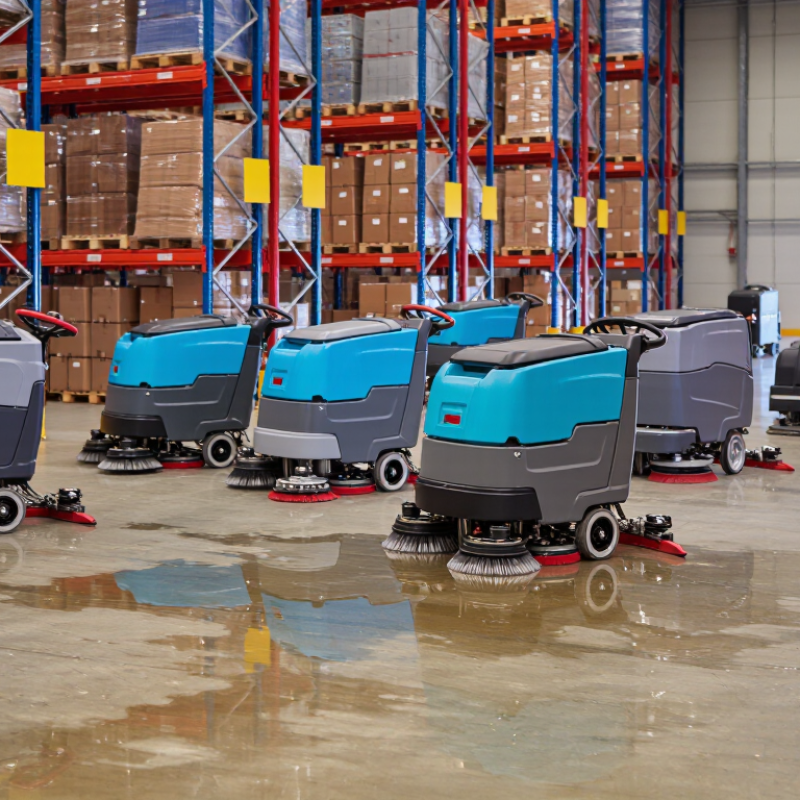
China Top Industrial Floor Scrubber Manufacturers

Definition and Role of Industrial Floor Scrubbers

An industrial floor scrubber is a powered machine that cleans hard surfaces with water, detergent, and rotating brushes. It loosens embedded soil, collects dirty liquid, and leaves the floor considerably drier than traditional mopping. Common models include walk-behind and ride-on designs. Their performance depends on brush pressure, water flow, suction strength, and battery capacity.

In warehouses, factories, hospitals, and logistics centers, scrubbers reduce slip risks and support consistent sanitation routines. A trained operator can clean wide aisles while controlling chemical use and wastewater. This matters near loading docks, where tire marks, oil residue, and fine dust gather quickly. Squeegees recover the solution behind the brush, but worn rubber can leave narrow wet trails. Small details matter.

Reliable manufacturers typically design machines around service access, operator visibility, and replacement-part availability. Buyers should examine tank capacity, noise levels, turning radius, and floor compatibility. Concrete, sealed stone, and coated surfaces may require different pads or detergents. More power is not always better. Excessive pressure can damage finishes or drain batteries quickly. Some specifications look impressive on paper, yet daily maintenance often decides real productivity. Operators still need training, inspection records, and sensible cleaning schedules. No machine fixes poor preparation.


Key Features of China’s Top Floor Scrubber Manufacturers

China’s top industrial floor scrubber manufacturers focus on practical cleaning results, not just polished specifications. Their machines often combine cylindrical or disc brushes with adjustable water flow and strong vacuum recovery. This matters in warehouses, factories, and shopping centers where dirt changes by zone.

I have found that reliable manufacturers explain brush pressure, cleaning width, battery capacity, and recovery-tank volume clearly. Vague numbers create problems during purchasing. Good suppliers also test machines on concrete, epoxy, and textured floors before delivery. A scrubber should leave a nearly dry path, even near expansion joints. Nearly dry matters.

Durable frames, sealed control panels, and accessible service points reveal serious engineering. Lithium or lead-acid battery options should match shift length, charging space, and maintenance skills. Noise control is important in occupied buildings. Operators also need adjustable handles, clear tank indicators, and simple emergency controls. These details reduce fatigue during long shifts.

Strong manufacturers provide spare-parts planning, operator training, and responsive technical support. Factory inspection records, electrical safety testing, and documented quality procedures improve purchasing confidence. However, customization can introduce weaknesses. A special brush or software change may complicate future repairs. I would request a trial, inspect welds and hoses, and measure water recovery personally. Marketing photos rarely show blocked filters, uneven floors, or rushed maintenance. That is where reliability is tested.

China Top Industrial Floor Scrubber Manufacturers - Key Features of China’s Top Floor Scrubber Manufacturers

Evaluation Dimension Typical Industrial Specification Common Options Available Why It Matters
Machine Configuration Walk-behind and ride-on industrial scrubber-dryers Compact, standard, heavy-duty, and autonomous-ready designs Supports different facility sizes, aisle widths, and cleaning schedules.
Cleaning Width Approximately 430–1,100 mm Single-disc, cylindrical, or dual-disc brush systems A wider cleaning path can improve productivity in warehouses and production halls.
Theoretical Productivity Approximately 1,500–6,500 m²/h Manual, assisted-drive, ride-on, and route-programmed operation Helps estimate labor requirements and daily cleaning capacity.
Solution Tank Capacity Approximately 30–250 L Separate clean-water and recovery-water tanks with level indicators Larger tanks reduce refilling and emptying interruptions during long shifts.
Battery System Lead-acid or lithium-ion; commonly 24 V or 36 V systems On-board charger, external charger, fast charging, and battery monitoring Battery selection affects operating time, charging speed, service life, and ownership cost.
Typical Runtime Approximately 2–6 hours per charge, depending on configuration Eco mode, standard mode, and replaceable battery packs Longer runtime is useful for large facilities and multi-shift operations.
Brush Pressure Approximately 20–100 kg, depending on machine class Fixed, adjustable, or electronically controlled pressure Adjustable pressure improves results on textured concrete, tile, epoxy, and coated floors.
Noise Level Approximately 58–75 dB(A), depending on operating mode Low-noise vacuum motors and reduced-noise eco settings Lower noise is beneficial in retail, healthcare, hospitality, and occupied facilities.
Water and Detergent Control Manual or electronically regulated solution flow Eco-flow, automatic dosing, chemical dilution control, and water-saving modes Controlled dosing can reduce water, detergent consumption, and floor drying time.
Recovery Performance Rear squeegee systems with vacuum-assisted water pickup Adjustable squeegee angle, floating squeegee, and anti-foam protection Effective recovery reduces slip risks and leaves floors ready for use sooner.
Control Interface Manual control panel or digital display Operating-hour counter, battery indicator, fault alerts, and password access Clear controls simplify operator training and routine maintenance.
Frame and Protection Corrosion-resistant steel or reinforced polymer construction Impact bumpers, sealed electrical components, and protected brush motors Durable construction is important in demanding industrial environments.
Floor Compatibility Concrete, epoxy, terrazzo, ceramic tile, vinyl, and sealed stone Soft, medium, abrasive, and specialized brush or pad selections Correct brush and pad selection helps prevent surface damage and improves cleaning quality.
Maintenance Design Tool-free access to filters, tanks, squeegees, and wear components Drain hoses, removable recovery tanks, washable filters, and quick-change blades Easy maintenance reduces downtime and supports consistent machine performance.
Quality and Compliance Indicators Documented quality-control procedures and applicable electrical safety compliance Factory testing, traceable components, user manuals, and export documentation Verification documents help buyers assess reliability, safety, and suitability for international use.

Note: Specifications are representative industry benchmark ranges for industrial floor scrubber-dryers. Actual performance varies according to machine configuration, floor condition, brush pressure, operator technique, battery type, and cleaning mode.

Main Types of Industrial Floor Scrubbing Equipment

Industrial floor scrubbers are built for different surfaces, traffic levels, and cleaning schedules. Walk-behind scrubbers suit narrow aisles, workshops, and areas below 10,000 square feet. Operators can control brush pressure and water flow closely. They also cost less to maintain. However, productivity depends heavily on operator pace.

Ride-on scrubbers cover large warehouses, logistics centers, and manufacturing floors faster. Their wider cleaning paths reduce labor time, but turning space matters. Battery capacity is another practical concern. A machine that stops during a production shift creates more disruption than expected. Cylindrical scrubbers combine scrubbing with light debris collection. They work well on textured concrete and uneven tile. Disk machines usually perform better on smooth floors with oily residue.

Autonomous scrubbers are gaining attention in facilities with repetitive layouts. A 2024 report from Grand View Research projects steady growth in the global floor cleaning machines market through 2030. Its analysis links growth to labor shortages and stricter hygiene expectations. These machines can record routes and cleaning results. Still, they require clear aisles, mapping, and human supervision. The technology is useful, not magical. In real sites, blocked paths and wet-floor changes can reduce performance.

Tips: Measure the cleaning area before choosing equipment. Check doorway width, floor texture, recovery-tank size, and charging access. Review manufacturer test data under conditions similar to your facility. A short on-site trial often reveals problems that brochures miss. Don’t select the largest machine automatically. Bigger is not always better.

Main Types of Industrial Floor Scrubbing Equipment

This chart compares representative operating benchmarks for major industrial floor scrubber categories. Cleaning path width indicates the working area covered per pass, while theoretical productivity represents the estimated maximum cleaning rate under ideal operating conditions. Actual performance varies with floor layout, operator speed, soil level, and water management.

How to Evaluate Chinese Floor Scrubber Suppliers

China Top Industrial Floor Scrubber Manufacturers

Evaluating Chinese floor scrubber suppliers requires more than comparing prices. Grand View Research estimated the global floor cleaning machines market at about USD 5.5 billion in 2023. It also projected growth above 7% annually through 2030. This expansion attracts capable factories and inexperienced traders. Request business licenses, production records, export references, and product test reports. A polished factory tour can still mislead.

Ask for measurable performance data. Compare cleaning width, brush pressure, recovery capacity, operating noise, battery life, and water consumption. Require tests on your actual floor surface. A warehouse concrete floor behaves differently from a coated workshop floor. Check whether claimed battery runtime reflects real working conditions. It often does not. Review the supplier’s quality system, incoming inspection process, and final testing records. ISO 9001 certification helps, but it cannot replace direct evidence.

The International Energy Agency reports that electric motor systems account for a major share of global electricity use. Efficient scrubber motors therefore affect long-term operating costs. Request energy-use data per cleaning hour, not only motor power. Examine spare-parts availability, technician training, warranty response times, and remote troubleshooting procedures. Ask for a sample maintenance schedule and service escalation process. Independent inspection before shipment is sensible for larger orders. I would also test one unit for several weeks. Early assumptions are easy to regret.

Applications, Standards, and Purchasing Considerations

Industrial floor scrubbers serve warehouses, food-processing plants, hospitals, shopping centers, and logistics hubs. Each site demands a different cleaning method. Warehouses need wide cleaning paths and strong dust control. Food facilities require chemical-resistant materials, easy drainage, and hygienic recovery tanks. Wet floors are unforgiving.

MarketsandMarkets’ 2024 Floor Cleaning Machines Market report projects steady global growth through 2029, driven by labor shortages and stricter hygiene expectations. This trend does not justify buying the largest machine. A compact ride-on unit may waste energy in narrow aisles, while a walk-behind scrubber can slow production across 20,000 square meters. Measure aisle width, floor texture, daily cleaning area, water access, and drying time before comparing quotations.

Compliance should remain practical. IEC 60335-2-72 addresses safety requirements for automatic floor-treatment machines. ISO 9001 certification can support consistent manufacturing controls, but it does not prove cleaning performance. Check battery protection, emergency-stop design, noise data, electrical ratings, and spare-part availability. For facilities in regulated regions, request conformity documents and local electrical approvals. Ask for test results on the actual floor coating, not polished showroom concrete. One overlooked issue is operator training. A powerful brush can damage soft resin flooring, and excessive detergent may leave a slippery film. Specifications look precise. Site trials are still imperfect, but they reveal more than brochures.

Scroll to Top