What Are the Top 10 Front Wheel Alignment Machines?
A Front Wheel Alignment Machine can turn a drifting steering wheel into a measurable diagnosis. The right choice matters in a busy workshop, where a vehicle waits on the lift and technicians need clear, repeatable readings. This guide compares ten leading machines through practical criteria: measurement accuracy, vehicle coverage, setup time, software usability, calibration support, and service availability.
Small details matter. A camera system may suit a shop with open floor space, while targets can be easier to manage in a tighter bay. A bright monitor helps under workshop lighting. Clamps must fit the wheels securely, and software should explain readings without hiding the technician’s judgment. No machine fixes poor setup. That deserves attention.
The expert quotation below is proposed wording, not a verified statement; confirm it with a named alignment specialist before publication: “[Expert Name], an alignment specialist, says, ‘Reliable alignment begins with accurate measurements and a technician who checks what the numbers mean.’” This comparison will distinguish useful features from sales claims, while noting that equipment needs vary by shop and vehicle mix. The rankings are a guide, not a substitute for a live demonstration, calibration records, or a careful review of local service support. Some trade-offs are unavoidable. A feature-rich system may also mean more training, higher costs, or extra setup steps.
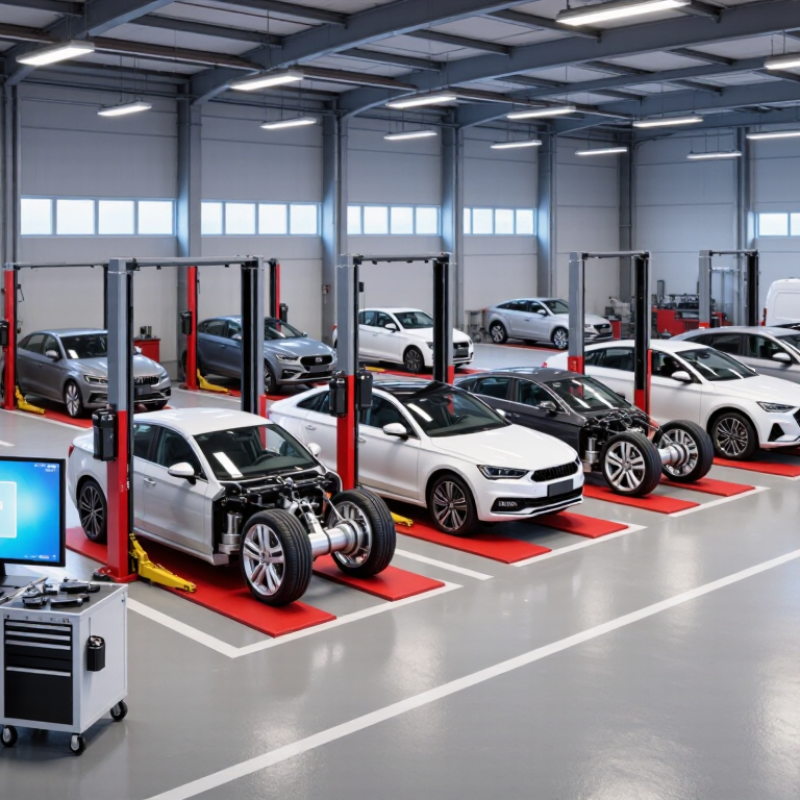
How Front-Wheel Alignment Machines Measure Steering Geometry
Front-wheel alignment machines do not “straighten” wheels by eye; they compare measured wheel planes with vehicle-specific targets. Cameras or electronic sensors read targets attached to the wheels, then calculate toe, camber, and caster. Toe shows whether the front edges point inward or outward. Camber is the wheel’s tilt viewed from the front. Caster measures steering-axis tilt from the side and affects steering stability. Small changes matter. Before measuring, a technician checks tire pressure, ride height, and worn joints, since loose parts can make precise screen readings misleading. Runout compensation, often performed by rolling the vehicle, helps separate target-mounting error from actual wheel geometry.
The machine compares readings with the vehicle’s specifications, not a universal ideal. It can also calculate thrust angle, showing whether the rear wheels push the vehicle away from its centerline. SAE International’s J670 standard provides common terminology for vehicle axes and motion. For context, the U.S. Department of Energy reports that each 1 psi drop in pressure across all four tires can reduce fuel economy by about 0.2 percent. That figure is not an alignment measurement, but it underlines why tire checks matter before diagnosis. Readings can still be affected by uneven loading or bent components. Recheck after adjustment, then road-test on a level route; equipment helps, but judgment still counts.

How Front-Wheel Alignment Machines Measure Steering Geometry
Sample front-axle readings (degrees)
Alignment machines use cameras or sensors to track targets mounted to the wheels and calculate steering angles. Toe and camber are measured at the wheels; caster is commonly calculated during a steering sweep. These readings are illustrative, not vehicle-specific targets. Positive toe denotes toe-in in this example; always use the vehicle manufacturer's specifications.
Key Features Used to Compare Alignment Machines
When comparing front wheel alignment machines, measurement quality matters more than a crowded feature list. Check the stated accuracy and repeatability, then consider how the system measures toe, camber, and caster. Clear readings help technicians spot small differences, especially when steering feels uneven after a repair. Small details matter.
Camera-based systems need a clear line of sight and suitable lighting. Sensor-based designs may require careful mounting and regular checks. Either way, ask how the equipment handles different wheel sizes and vehicle types. A broad vehicle database saves lookup time, but update frequency matters too. Outdated specifications can send a careful technician in the wrong direction.
Consider the workshop itself. Will the equipment fit the lift, and can a vehicle be positioned without blocking nearby bays? Look at setup time, screen readability, and whether the workflow guides users through each measurement. Training and calibration support are practical comparison points, not extras. A polished interface can still slow work if menus are confusing. No machine removes the need to inspect tires, suspension, and steering components before trusting its readings. That step is easy to rush on a busy day.
Types of Front-Wheel Alignment Systems and Their Technologies
What Are the Top 10 Front Wheel Alignment Machines?
Types of Front-Wheel Alignment Systems and Their Technologies
Front-wheel alignment systems measure angles such as toe, camber, and caster. Optical systems use targets and cameras to compare wheel positions. CCD systems track sensor signals from heads attached to the wheels. Both need careful setup; a loose clamp can distort readings. Some systems use lasers to show alignment changes, though the operator still needs to interpret the measurements.
Three-dimensional systems use cameras to read targets mounted on each wheel. They can display measurements quickly and help technicians spot changes during adjustment. A front-only setup can assess the front axle, but it may miss a rear thrust-angle problem that affects steering. For that reason, check what each machine actually measures rather than judging it by its screen. No system is magic. Targets can sit crooked, and worn suspension parts can make accurate readings hard to act on.
Tips: Check tire pressure and inspect steering and suspension parts before measuring. Center the steering wheel, secure the targets, and follow the machine’s compensation procedure. Recheck after adjustment. Small setup errors matter. A clean, level alignment bay helps, but it does not replace a careful technician.
Ten Front-Wheel Alignment Machines and Their Distinguishing Features
What Are the Top 10 Front Wheel Alignment Machines?
Ten Front-Wheel Alignment Machines and Their Distinguishing Features
Front-wheel alignment systems differ in how they measure angles and fit a workshop. Camera-based 3D systems track targets on each wheel, while CCD systems use electronic sensor heads. Laser systems project reference lines; infrared systems transmit measurements without visible beams. Wireless sensor-head setups reduce cables around the vehicle. Rolling-compensation systems measure wheel movement as a vehicle rolls over the turn plates. Drive-on platforms suit quick positioning, while scissor-lift systems save floor space. Portable alignment units can serve smaller bays. Tablet-connected systems display readings beside the vehicle. These configurations can overlap, so ten labels do not mean ten completely separate technologies.
Tips: Check calibration, vehicle coverage, target condition, and lift compatibility before choosing. Small setup errors matter.
A useful system shows front toe, camber, and caster clearly, and guides the technician through measurement. Look for repeatable readings and a straightforward calibration process, not just a fast screen. Older targets may need careful handling. No setup is perfect; workshop space, service volume, and technician training affect the result as much as the machine.
What Are the Top 10 Front Wheel Alignment Machines? — Ten Front-Wheel Alignment Machines and Their Distinguishing Features
| Rank | Machine Type | Measurement Method | Typical Setup | Distinguishing Feature | Best Suited For |
|---|---|---|---|---|---|
| 1 | Four-Wheel 3D Imaging Aligner | Cameras track targets mounted on the wheels to calculate alignment angles. | Vehicle positioned on an alignment lift; targets are attached to all four wheels. | Measures all four wheels together and can show rear thrust direction alongside front-wheel readings. | General repair shops that perform both front- and four-wheel alignment. |
| 2 | CCD Sensor-Based Aligner | Electronic sensor heads communicate angle measurements between wheel-mounted units. | Sensor heads are clamped to the wheels and connected by cables or wireless links, depending on configuration. | Provides live measurement updates while technicians adjust steering and suspension components. | Shops seeking an established electronic measurement workflow. |
| 3 | Front-Axle Two-Wheel Aligner | Measures front-wheel angles, commonly including toe and camber; caster measurement depends on the system and procedure. | Targets or sensors are fitted to the two front wheels, with the vehicle on turntables. | Concentrates on front-axle measurements rather than providing a complete four-wheel alignment assessment. | Applications where front-wheel alignment is specifically required and rear-axle geometry is not being assessed. |
| 4 | Wireless Sensor Aligner | Wheel-mounted electronic sensors transmit measurement data wirelessly to a console. | Sensor heads are attached to the wheels; the display is positioned near the vehicle. | Reduces cables around the lift area and allows the operator to view readings away from the console. | Busy workshops prioritizing an uncluttered work area. |
| 5 | Drive-Through Imaging Aligner | Fixed cameras read wheel targets as the vehicle passes through the measurement area. | Camera units are installed beside or around a designated drive-through bay. | Can capture a rapid initial alignment check without first mounting conventional sensor heads. | High-throughput inspection lanes and service operations that need quick screening. |
| 6 | Portable Alignment System | Compact electronic sensors or optical targets measure wheel angles and send results to a portable display. | Equipment is transported to a suitable, level work area and set up around the vehicle. | Can be moved between bays or locations instead of remaining permanently installed in one alignment lane. | Mobile service work, smaller facilities, or shops with changing bay layouts. |
| 7 | Runout-Compensation Aligner | Uses a wheel-rolling or wheel-turning procedure to account for wheel and mounting irregularities in measurements. | Wheel targets or sensor heads are mounted; the vehicle is rolled or the wheels are rotated as instructed. | Compensation helps reduce measurement error caused by imperfect wheel or clamp positioning. | Shops seeking repeatable readings, particularly when wheel mounting conditions vary. |
| 8 | Low-Profile Lift Alignment System | Uses camera-based or electronic wheel sensors to measure alignment angles on a compatible lift. | Installed with a lift and turntables suited to vehicles with limited ground clearance. | Pairs alignment measurement with a setup intended to accommodate low-clearance vehicles. | Performance, sports, and other low-profile passenger vehicles, subject to lift capacity and clearance. |
| 9 | Commercial-Vehicle Alignment System | Uses suitable sensors or optical equipment to measure steering and axle geometry on larger vehicles. | Requires a compatible heavy-vehicle bay, lifting equipment, and vehicle-specific measurement data. | Designed around the greater dimensions and axle configurations found on commercial vehicles. | Truck and fleet service facilities; equipment capacity must match the vehicle being serviced. |
| 10 | Alignment System with ADAS Workflow Support | Measures wheel alignment using cameras or electronic sensors; some workflows also interface with separate calibration equipment. | Requires alignment equipment and, when needed, compatible ADAS calibration tools and procedures. | Can help coordinate wheel alignment and driver-assistance sensor calibration workflows; alignment equipment alone does not calibrate every ADAS sensor. | Shops servicing vehicles with driver-assistance systems and following the vehicle maker’s calibration requirements. |
These entries describe common alignment system types, not specific products. Available measurements, vehicle coverage, and procedures vary by equipment configuration and vehicle specifications.
How to Choose a Machine for Different Workshop Needs
A workshop should choose a front wheel alignment machine around its daily work, not a ranking alone. Start with the vehicles you service: passenger cars, light vans, or a mixed fleet. Check that the system measures the angles your procedures require, including toe, camber, and caster. Rear-wheel readings can also reveal thrust-angle problems that affect front alignment. Small detail. Big difference.
Space and workload matter. A compact shop may benefit from a mobile system that can be moved between bays, while a high-volume center may prefer fixed sensors and quick vehicle measurements. Camera-based systems can reduce setup steps, but they need a clear line of sight and suitable targets. Older sensor-based equipment may fit a tighter budget, though it can require more careful mounting and handling. Compare lift compatibility, floor conditions, and the time needed to set up each vehicle.
Think about the people who will use the machine. A clear interface, guided procedures, and accessible training can help newer technicians avoid missed steps. Ask how calibration is checked, where replacement parts come from, and what support is available when readings seem inconsistent. Do not rely on impressive specifications alone. A demonstration using one of your own vehicles is more revealing. I would still leave room for a learning curve; even good equipment cannot correct rushed measurements or worn suspension components.