7 Tips for Buying Heat Meters for Global Projects?
Buying Heat Meters for global projects is rarely as simple as comparing prices on a supplier website. A device that performs well in a small European apartment may struggle in a dusty construction site, a high-rise plant room, or a district heating network with unstable water quality. Project teams must examine flow range, temperature accuracy, pressure loss, communication protocols, installation orientation, and long-term maintenance requirements. Small details matter.
Field experience often reveals problems that product brochures do not mention. A meter may fit the pipe perfectly but provide weak wireless coverage inside concrete shafts. Another model may offer impressive accuracy, yet require a specialist technician for calibration. Battery life also deserves attention, especially when meters are installed in difficult-to-access cabinets. Ask for test reports, certification records, sample data, and clear warranty terms. Do not rely on attractive specifications alone.
Global procurement adds another layer of uncertainty. Regional standards, import conditions, software languages, spare-part availability, and local service capacity can affect the total project cost. It is wise to test representative units before placing a large order. Still, even a pilot test cannot predict every field condition. That limitation should be acknowledged, not hidden. A practical buying decision balances measurement accuracy, integration needs, project risks, and future support. The cheapest meter may become the most expensive choice after repeated replacements, inaccurate billing, or delayed commissioning. These seven tips will help project owners, engineers, and procurement teams evaluate Heat Meters with greater confidence and fewer costly surprises.
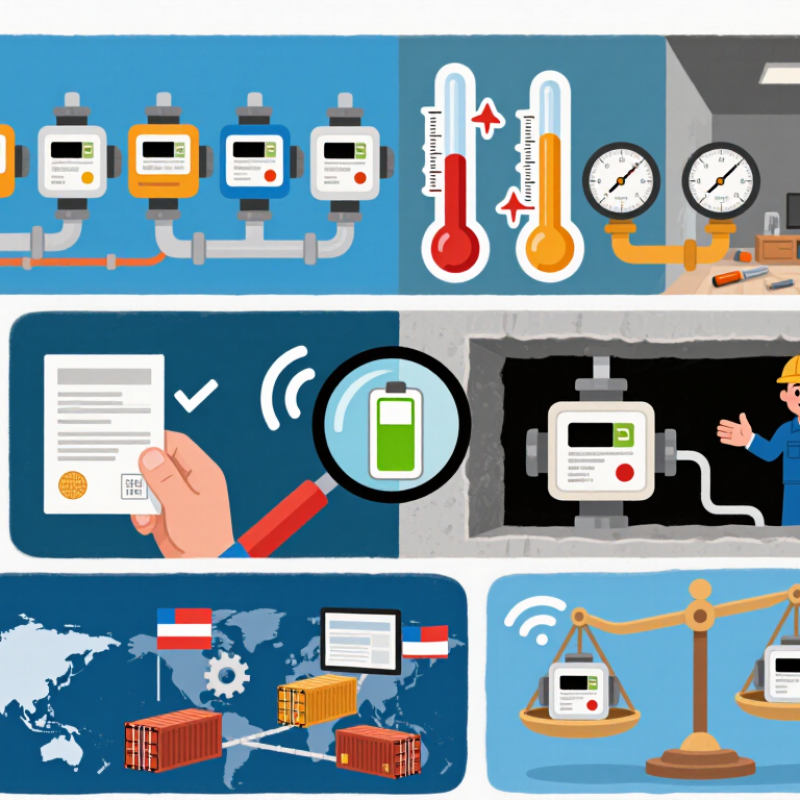
Define Project Requirements and Heat Meter Performance Goals
7 Tips for Buying Heat Meters for Global Projects
Define Project Requirements and Heat Meter Performance Goals
A reliable purchase begins with the building, not the catalog. Record the heat source, pipe diameter, flow range, fluid quality, pressure, temperature range, and installation space. Specify whether the meter serves one apartment, a campus, or a district network. Site surveys often reveal cramped valve rooms and unstable power supplies. These details can change the correct meter design.
Set measurable performance goals before comparing quotations. Define allowable measurement error, minimum starting flow, response time, battery life, data interval, and communication protocol. EN 1434 and OIML R 75 provide useful technical references for heat measurement. The IEA’s Buildings 2023 report states that buildings consume about 30% of global final energy. Small measurement errors can therefore distort major efficiency decisions. IEA data also shows that space heating remains a substantial building energy load.
Global projects need more than laboratory accuracy. Check performance under local humidity, freezing conditions, water chemistry, vibration, and intermittent connectivity. Confirm factory testing, traceable calibration, verification intervals, and service procedures. Ask for raw data access. It supports audits and troubleshooting. The UNEP Global Status Report for Buildings and Construction 2023 attributes roughly 34% of global energy demand to buildings. That figure makes dependable monitoring commercially important, not merely technical. Still, specifications are sometimes too optimistic. A meter may meet its class on paper but struggle in a poorly prepared pipe section. Include straight-pipe requirements, commissioning checks, and a realistic uncertainty budget.
Verify Standards, Certifications, and Regional Compliance
Buying heat meters for a global project requires more than comparing flow range and display features. Regional compliance can determine whether a meter is accepted, installed, and billed legally.
Tip 1 Identify the governing standard before requesting quotations. EN 1434 and OIML R 75 may apply, but local rules can differ.
Tip 2 Request complete certificates, not marketing statements. Check certificate numbers, issuing bodies, test dates, and covered meter configurations.
Tip 3 Confirm legal metrology approval for billing applications. A technically accurate meter may still be unsuitable for regulated transactions. Small details matter.
Tip 4 Review regional electrical and radio requirements. Wireless models may need different approvals across countries.
Tip 5 Match the certificate to the actual sensor pair, calculator, software, and installation method. Partial documentation creates avoidable risks.
Tip 6 Verify laboratory traceability and calibration uncertainty. Ask how testing was performed, not only where it occurred.
Tip 7 Check environmental ratings, temperature limits, EMC testing, and sealing requirements for the installation site.
A practical review should compare certificates against the project’s country list and contract specifications. Translation quality deserves attention too. One unclear phrase can delay approval. I have seen teams focus heavily on accuracy while overlooking import documentation and local inspection procedures. That is an easy mistake to repeat. Keep a compliance matrix for every destination, and update it when regulations change. Some assumptions will be wrong. Test them early.
Compare Meter Technologies, Accuracy, and Installation Conditions
Buying heat meters for global projects requires more than comparing prices. Start by matching the technology to the site. Mechanical meters can suit clean, stable water systems. Ultrasonic meters usually handle wider flow ranges and create less pressure loss. Electromagnetic meters may work well with conductive fluids, but they need suitable installation conditions. Always check the actual fluid, not the expected fluid.
Accuracy depends on more than the stated class. Review flow accuracy, temperature sensor tolerance, response time, and calculator performance together. Ask for calibration records from an accredited laboratory. Compare results at low, normal, and peak flow rates. A meter that performs well at design flow may drift during night-time operation. That detail matters. Check whether paired temperature sensors are supplied and matched. Unpaired sensors can distort billing data.
Installation conditions deserve equal attention. Confirm pipe diameter, available straight lengths, mounting direction, ambient temperature, and service access. Turbulence from valves or pumps can weaken readings. Poor sensor contact can do the same. Check water quality, air bubbles, pressure, and glycol concentration before selection. Communication protocols should match the project’s control system and local data requirements. In field reviews, I have seen accurate meters fail because technicians installed them in cramped spaces. I also learned that supplier diagrams are not always enough. Leave room for inspection. Specify commissioning tests, remote readings, seal protection, and replacement procedures before shipment.
Assess Suppliers, Lifecycle Costs, Support, and Global Delivery
For global heat-meter projects, supplier assessment should go beyond unit price. Check EN 1434 compliance, measurement accuracy, temperature range, communication protocols, and calibration records. Ask for independent test reports. A low-cost meter can become expensive when replacement parts arrive slowly. It happens.
Lifecycle cost deserves a clear spreadsheet. Include installation, batteries, data integration, recalibration, software access, repairs, and disposal. The UNEP Global Status Report for Buildings and Construction 2023 states that buildings used about 32% of global energy and produced approximately 34% of global carbon emissions in 2022. Accurate metering supports better control, but only when readings remain reliable. Compare warranty length, expected battery life, and the supplier’s documented failure rates. The cheapest option is not always economical.
Global delivery needs practical evidence. Confirm export packaging, customs documents, local certifications, spare-parts locations, and delivery lead times for each region. Require a named technical contact and response targets for urgent faults. Remote commissioning can reduce delays, yet it cannot replace local training. The IEA Energy Efficiency 2023 report noted that global efficiency improvement reached about 2.2% in 2022, while the 2030 pathway requires roughly 4% annually. Meter data alone will not close that gap. Project teams should test sample readings, audit communication performance, and challenge optimistic supplier claims. I would also leave contingency budget for integration problems; this is often overlooked.
Create a Testing, Commissioning, and Maintenance Plan
For global heat-meter projects, a testing, commissioning, and maintenance plan should be written before purchase orders are issued. Buildings consume about 30% of global final energy, according to the International Energy Agency’s Global Status Report for Buildings and Construction 2023. Meter accuracy therefore affects both operating costs and carbon reporting.
Use seven practical checkpoints. Define the heating circuit, measurement range, fluid temperature, communication protocol, and local legal requirements. Require calibration certificates with traceable uncertainty. Test each flow sensor and temperature probe before shipment.
Inspect pipe direction, straight-run requirements, insulation, and sensor pockets on site. Record a baseline during stable operation. Compare readings against a calibrated reference instrument. Finally, document settings, test results, drawings, and operator training.
Keep testing specific. A commissioning record should show flow rate, supply temperature, return temperature, calculated energy, pulse output, and time stamps. Test low, normal, and peak flow conditions. Small installation errors can distort results. Do not trust a perfect factory certificate alone.
The Lawrence Berkeley National Laboratory’s 2009 commissioning study reported median energy savings of 13% in existing buildings and 8% in new buildings.
Maintenance should follow risk, not habit. Check data alarms monthly, inspect wiring and seals annually, and recalibrate according to drift evidence and regulations. Store spare sensors and backup readings for critical sites. This plan may still miss unusual water chemistry or seasonal behavior. Review it after the first heating cycle.