
425 Sovereign Ct. St. Louis, MO 63011
SEARCH OUR WEBSITE

10 Firefighting Drones Tips for Global Buyers

Buying Firefighting Drones is not simply a technology decision. It is a field-readiness decision involving heat, smoke, wind, battery limits, and human judgment. Global buyers need equipment that performs beside burning warehouses, forest edges, industrial sites, and narrow urban streets. A polished product brochure cannot reveal everything.

Charles Werner, founder of DRONERESPONDERS and a recognized public-safety drone expert, has said, “Drones are a force multiplier for public safety.” That idea matters. A drone can provide an overhead view before crews enter danger, identify heat through a thermal camera, and help commanders track changing conditions. However, it cannot replace trained firefighters or sound incident management.

This guide presents ten practical tips for evaluating Firefighting Drones across international markets. It considers thermal accuracy, flight endurance, payload options, weather resistance, transmission range, maintenance access, operator training, and data protection. Certification and local aviation requirements also deserve careful review. They vary widely.

Look beyond specifications.

A drone rated for 40 minutes may fly far less in strong wind or freezing temperatures. A camera may detect hot spots, yet produce confusing images through heavy smoke. These details can affect real decisions. Procurement teams should request demonstrations, service records, replacement-part plans, and honest performance limits.

Some recommendations may not fit every department. That is the uncomfortable part. Budgets, terrain, staffing, and emergency procedures differ. Buyers should test assumptions before signing contracts, then measure results after deployment. Reliable purchasing begins with evidence, not excitement.
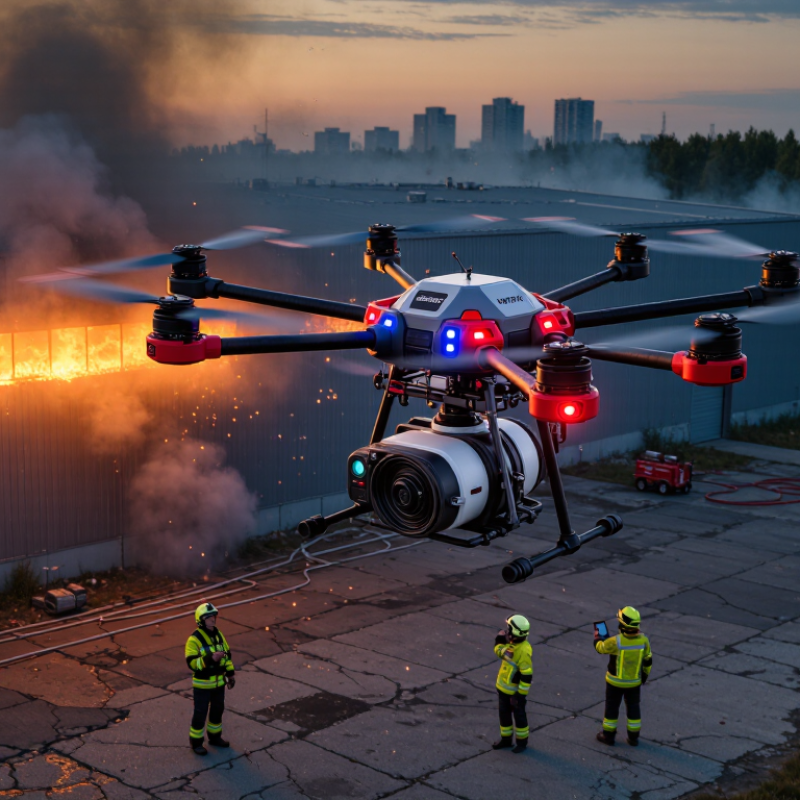
10 Firefighting Drones Tips for Global Buyers

Understanding Firefighting Drone Types and Their Core Functions

10 Firefighting Drones Tips for Global Buyers

Firefighting drones usually fall into three practical types: aerial observation, tethered support, and heavy-lift systems. Multirotor observation drones provide thermal imaging, live video, and roof-level inspection. Tethered units can remain overhead for hours, supplying continuous light, video, or communications support. Heavy-lift drones carry larger thermal cameras, loudspeakers, or approved suppression payloads. Their roles differ sharply.

NFPA’s Fire Loss in the United States During 2023 estimated 1,388,500 fires and about 3,670 civilian fire deaths. This scale explains why rapid scene intelligence matters. A thermal drone can reveal hot spots behind walls, while an RGB camera checks smoke movement and structural damage. Buyers should compare flight time, sensor resolution, wind resistance, IP rating, and secure data storage. A bright screen is not enough.

Real deployments expose uncomfortable limits. Smoke, rain, heat, magnetic interference, and dense buildings can weaken navigation. Battery swaps also slow operations. Tethered drones solve endurance problems, but they need safe anchoring space. Heavy-lift models require stronger training and careful payload control. Regulations for night flights, remote operations, and beyond-visual-line-of-sight missions vary by country. The FAA and EASA both emphasize operational authorization and pilot responsibility. Procurement teams should test drones with local crews, not only in clear weather. That is where weaknesses appear.


Defining Mission Requirements and Selecting Suitable Drone Features

10 Firefighting Drones Tips for Global Buyers

Defining Mission Requirements and Selecting Suitable Drone Features

Define the fire before defining the drone. A forest incident may require thermal mapping, while an urban response may need roof inspection and survivor location. Ask practical questions: How large is the operating area? How long must the drone remain airborne? Will smoke, rain, heat, or strong wind reduce performance? Keep it practical. Mission distance also affects communication systems, battery planning, and pilot workload.

Choose features that directly support these tasks. A radiometric thermal camera can reveal hot spots through darkness and light smoke, while a high-resolution visual camera helps inspectors assess structural damage. Obstacle avoidance is valuable near towers, trees, and unstable buildings. Reliable positioning matters, but it should not replace trained piloting. Consider spare batteries, rapid charging, weather resistance, secure data storage, and clear maintenance procedures. A heavy payload may sound useful, yet it can reduce endurance and handling stability.

Global buyers should check aviation rules, radio requirements, privacy obligations, and local emergency procedures before purchase. Documentation should include test results, operating limits, battery guidance, and staff training plans. A perfect specification rarely survives real fire conditions. Field teams often discover that glare, ash, and heat distort images. Test the complete system in controlled exercises, then revise the requirements. The best choice is not the most advanced drone, but the one crews can operate safely under pressure.

Evaluating Safety, Sensors, Flight Performance, and Payload Capacity

For global buyers, firefighting drones should be judged in realistic conditions, not only through specification sheets. Safety begins with reliable obstacle detection, return-to-home functions, battery warnings, and stable communication links. Ask for documented tests in smoke, heat, wind, and reduced visibility. A drone that performs well over an open field may struggle near towers, trees, or water spray.

Tip: Check sensor performance at night and through smoke. Thermal cameras can reveal hidden hotspots, but they may misread reflective metal or dense steam. Visible-light cameras still matter for identifying doors, cables, and structural damage. Keep it measurable. Request sample footage, detection ranges, calibration procedures, and maintenance intervals. Local aviation and emergency-service requirements should also guide procurement.

Flight performance affects every rescue decision. Evaluate hover stability, wind resistance, climb speed, operating range, and landing accuracy. Payload capacity must cover the camera, lights, speaker, protective housing, and any approved measuring equipment. More capacity often reduces endurance, so compare useful payload with actual flight time. A claimed forty-minute flight may become twenty-five minutes in cold weather or strong wind. No test is perfect. Buyers should repeat demonstrations with trained operators, record battery levels, and inspect performance after repeated flights. Reliability comes from evidence, not impressive numbers.

How to use this chart: The percentages represent a practical procurement-planning model for global buyers. Safety, thermal sensing, reliable communications, flight endurance, weather tolerance, and payload capability should be verified through test reports, operating manuals, compliance documents, and field demonstrations. The weighting is an evaluation guide, not a ranking of any supplier or brand.

Checking Global Regulations, Certifications, Training, and Data Policies

10 Firefighting Drones Tips for Global Buyers

Before purchasing, check the aviation rules in every intended country. A drone approved for one market may need fresh registration elsewhere. Confirm operating limits, pilot licenses, night-flight permissions, radio frequencies, and insurance requirements. Ask for recognized safety certifications, test reports, and maintenance records. Do not rely on a sales brochure alone.

Training needs practical depth. Operators should practice thermal searches, smoke-filled scenes, high-wind flights, battery changes, and emergency landings. Include privacy training, because cameras may capture homes, roads, or injured people. Data policies deserve equal attention. Confirm where video is stored, who can access it, how long records remain, and whether cross-border transfers are permitted. Request encryption details and clear deletion procedures.

Check payload limits before expecting water delivery or heavy sensors. Test flight endurance near buildings, towers, and heat sources. Create a written chain of custody for incident footage. It may support investigations later. Verify local import controls, customs documents, repair access, and spare battery transport rules. A certificate is useful, but it does not prove field readiness. I would require a supervised demonstration with local crews. Real smoke behaves unpredictably. One overlooked setting can reduce thermal visibility during a rescue. That uncomfortable lesson should shape the buying decision.

Comparing Suppliers, Total Costs, Maintenance, and After-Sales Support

Global buyers should compare firefighting drone suppliers beyond camera quality and flight range. Request test records, operator training details, production capacity, and references from emergency-response users. A capable supplier should explain heat resistance, water protection, battery limits, and safe operating distances in plain language. Vague answers are a warning sign.

Tip 1: Calculate the total cost before signing. Include aircraft, thermal cameras, batteries, charging equipment, software, shipping, import duties, training, insurance, and replacement parts. A lower purchase price may hide expensive batteries or subscription fees. Ask for a three-year ownership estimate. Leave room for unexpected repairs.

Maintenance directly affects response readiness. Check battery replacement intervals, motor inspection procedures, firmware support, and storage requirements. Ask whether technicians can diagnose faults remotely and how quickly common parts can arrive. Keep a written maintenance log after every flight. Small oversights matter during a hot, smoky deployment.

Tip 2: Examine after-sales support like an emergency service. Confirm response hours, escalation contacts, repair turnaround times, spare-part availability, and warranty exclusions. Support should continue after installation, not disappear after payment. However, buyers should test these promises with a pre-sales technical question. The reply speed reveals something.

Tip 3: Compare suppliers using the same checklist and a supervised field trial. Test launch time, thermal visibility, wind stability, battery endurance, and video transmission near structures. Results can differ from brochures. Also verify local aviation, radio, privacy, and safety requirements before deployment. A technically strong drone still fails if the operating plan is incomplete.

10 Firefighting Drones Tips for Global Buyers - Comparing Suppliers, Total Costs, Maintenance, and After-Sales Support
No. Buyer Tip Comparison Dimension Practical Benchmark Cost Consideration Supplier Verification Maintenance & After-Sales Check
1 Define the mission before comparing aircraft Primary firefighting role Separate requirements for thermal reconnaissance, command support, water or foam delivery, and post-fire inspection. A surveillance drone normally has very different payload and endurance requirements from a suppression drone. Avoids paying for unnecessary payload capacity or specialized equipment. Request a written performance matrix showing payload, endurance, operating temperature, wind tolerance, and intended mission profile. Confirm that training, operating procedures, spare parts, and software support match the selected mission.
2 Compare usable flight time, not only the advertised maximum Endurance under operational load Typical multirotor firefighting platforms may provide approximately 20–45 minutes of flight time per battery in favorable conditions; payload, wind, temperature, and reserve requirements reduce usable time. Budget for additional batteries, chargers, transport cases, and battery replacement cycles. Ask for test conditions, payload weight, wind speed, battery reserve, and the method used to calculate endurance. Check battery cycle-life data, storage requirements, charging limits, and replacement lead time.
3 Evaluate thermal and optical sensing together Detection capability A useful emergency configuration commonly combines a visible-light camera, radiometric or temperature-measuring thermal camera, image stabilization, and geotagged video. Thermal resolution, radiometric capability, zoom, and stabilization can materially change the system price. Require sample imagery, thermal accuracy specifications, calibration information, low-light performance, and data-export formats. Confirm lens protection, sensor calibration intervals, firmware support, and replacement-camera pricing.
4 Check payload performance separately from aircraft capacity Payload mass, flow rate, and delivery distance For water or foam delivery, compare usable tank volume, discharge rate, effective range, refill method, and flight time while fully loaded. A larger nominal tank does not guarantee better suppression performance. Pumps, hoses, tanks, nozzles, foam-compatible components, and refill equipment may be priced separately. Request a live demonstration using the proposed liquid, nozzle, operating height, and target distance. Inspect pump seals, filters, nozzles, corrosion protection, flushing procedures, and replacement intervals.
5 Compare communications and control resilience Control range, video link, and redundancy Practical range depends on terrain, buildings, radio congestion, antenna placement, and local regulations. Look for encrypted command links, lost-link behavior, return-to-home settings, and optional network connectivity. Long-range radios, mobile command units, repeaters, satellite connectivity, and network subscriptions may add recurring costs. Request an on-site or representative environment test rather than relying only on an open-field range claim. Verify radio availability in the destination country, antenna support, cybersecurity updates, and replacement-control-unit policy.
6 Calculate total cost of ownership Acquisition plus operating cost Include the aircraft, payloads, batteries, charger, controller, software, training, transport case, insurance, import charges, regulatory fees, and planned spare parts over a 3–5 year period. A realistic budget should separate one-time costs from annual costs such as software, connectivity, inspections, insurance, and battery replacement. Ask for a complete bill of materials and a five-year cost model with taxes, shipping, warranty exclusions, and service rates. Compare hourly operating cost, scheduled service cost, battery replacement cost, and downtime cost.
7 Assess regulatory and environmental suitability Legal operation and weather envelope Confirm aircraft registration, pilot qualification, operating restrictions, night-flight rules, privacy requirements, radio approvals, and dangerous-area procedures. Check stated limits for wind, rain, smoke, heat, and temperature. Permits, operator training, insurance, local certification, and compliance modifications may be required before deployment. Request country-specific compliance documents, technical files, declarations, manuals, and serial-number traceability. Confirm that regulatory updates, software changes, and safety notices are communicated to operators.
8 Compare supplier quality and delivery capability Manufacturing consistency and fulfillment Evaluate production capacity, quality-control procedures, acceptance testing, documentation quality, serial-number records, and the supplier’s ability to deliver batteries and critical parts with the aircraft. Lower purchase prices may create higher costs through inconsistent quality, missing accessories, customs delays, or unavailable parts. Use factory-acceptance tests, pre-shipment inspection, sample serial records, packaging specifications, and a clearly defined delivery schedule. Ask whether critical components are stocked regionally and how long standard and non-standard parts typically take to ship.
9 Examine training and operational readiness Operator, technician, and incident training A procurement package should cover pilot operation, thermal-image interpretation, payload handling, battery safety, emergency procedures, data management, and routine inspection. Include instructor travel, refresher courses, simulator access, local-language materials, and staff replacement training. Request a training syllabus, competency assessment, course duration, instructor qualifications, and records of practical exercises. Prefer suppliers offering refresher training, troubleshooting guides, remote assistance, and technician-level courses.
10 Make after-sales support measurable in the contract Warranty, repair turnaround, and service-level commitment Define warranty duration, covered components, response time, repair-or-replace rules, software support period, loan equipment, and escalation contacts before purchase. A support plan may cost more initially but can reduce mission downtime and emergency shipping expenses. Obtain written service-level terms, exclusions, return procedures, remote-diagnostic capability, and technical-support hours across time zones. Set target response times, maximum repair turnaround, spare-parts availability, battery disposal guidance, and end-of-life support.
Planning note: Cost ranges, endurance figures, and operational benchmarks vary by aircraft configuration, payload, climate, regulations, logistics, and mission profile. Buyers should validate all figures through documented tests and a destination-country compliance review.
Scroll to Top