How to Choose a Tunnel Kiln in 2026
In 2026, choosing a Tunnel Kiln means balancing product quality, production targets, energy use, and maintenance demands. The International Energy Agency’s Energy Efficiency 2023 report estimates that industry used about 37% of global final energy in 2022. That figure is not a kiln benchmark, but it shows why firing efficiency deserves careful attention. The U.S. Department of Energy’s Industrial Decarbonization Roadmap also identifies process heat and energy efficiency as important industrial priorities. Buyers should therefore compare real operating data, not rely only on a supplier’s headline capacity or fuel-consumption claim.
Start with the product and production line. Record the ware dimensions, clay or ceramic body, required firing temperature, daily output, and acceptable reject rate. Then ask for the kiln’s temperature-uniformity data, firing-curve controls, fuel options, refractory specifications, and expected maintenance intervals. A fast line can still disappoint if the firing profile causes uneven color or weak pieces. Small details matter. Check how trays move through the kiln, where operators inspect burners, and how quickly routine repairs can be completed. Request references from plants making comparable products, plus measured consumption under similar operating conditions. A site visit helps. Still, no brochure can replace a careful review of your own fuel prices, utilities, layout, and staffing. Those assumptions are easy to overlook, and they can change the economics. The right Tunnel Kiln is not simply the largest or newest model; it is the one whose verified performance fits the plant’s products and operating realities.
Define Production Requirements and Material Characteristics
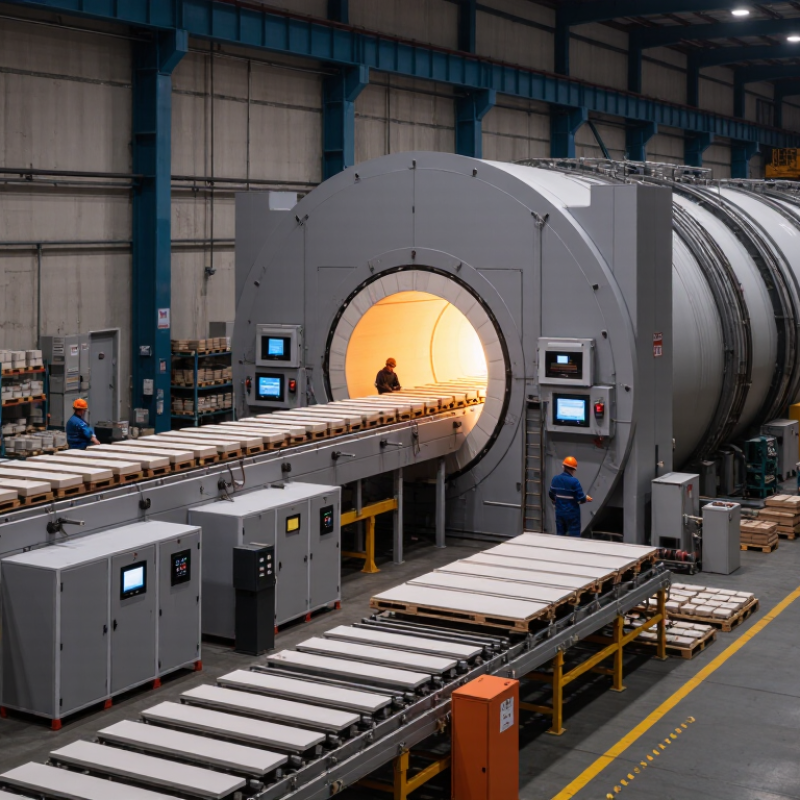
A tunnel kiln should be sized around the product, not a catalogue capacity. Define daily output, operating hours, product dimensions, and acceptable variation before comparing designs. For ceramic products, the European Commission’s 2007 Ceramic Manufacturing BREF reports firing ranges that differ by product: roughly 800–1,200°C for bricks and 1,000–1,300°C for wall and floor tiles. These are broad reference ranges, not a firing recipe. Confirm the actual heatwork with test pieces.
Material behaviour matters just as much. Record moisture, shrinkage, thermal expansion, and sensitivity to rapid heating or cooling. A damp green body may crack; a tightly packed load may develop uneven temperatures. Include kiln furniture and spacing when calculating usable width and height. Small details matter. The U.S. Department of Energy’s process-heating guidance estimates that heating accounts for about half of manufacturing energy use, so compare fuel use at your expected load and schedule—not only at rated capacity. Ask for temperature-uniformity data across the loaded kiln. That part is easy to overlook. I would also test representative samples at the proposed cycle; laboratory results do not always predict a full production load.

Compare Tunnel Kiln Types, Layouts, and Capacity
Choosing a tunnel kiln starts with the product, not the catalogue capacity. Car-type kilns suit heavy, varied loads that need stable support; roller-hearth layouts can move smaller, flatter wares quickly. Pusher systems may fit dense, repetitive production. Each layout changes loading access, floor space, and maintenance needs. Small details matter.
Capacity should be calculated in fired tonnes per day, then checked against the actual firing cycle, car pitch, and usable kiln width. A long kiln is not automatically a high-output kiln. The U.S. Department of Energy’s 2015 process-heating sourcebook estimates that heating accounts for about two-thirds of U.S. manufacturing energy use. That figure makes insulation, exhaust heat recovery, and burner control worth comparing alongside rated throughput. Ask suppliers for performance data using your product and loading pattern.
Walk the proposed layout on the floor plan. Can operators load carts without blocking the dryer exit? Is there room to repair rollers or replace a kiln car? I would also test the estimate against a slow-shift scenario; peak figures can look reassuring. They do not always match daily production. Product mix, moisture, and firing temperature can shift real capacity, so leave practical room for change.
Evaluate Temperature Control, Energy Use, and Automation
How to Choose a Tunnel Kiln in 2026
A tunnel kiln should hold a stable temperature across its firing zones, not just reach a high peak. Ask for temperature-mapping data under a representative load. Compare sensor locations, control response, and the size of temperature swings during normal production. A few degrees can affect color, strength, or shrinkage. Numbers can mislead, though: an empty-kiln test may not reflect shelves, ware spacing, or a full shift.
Tips: Request fuel or electricity use per unit of saleable product, not just hourly consumption. Check how the estimate changes with different loads and firing schedules. Ask whether waste-heat recovery is practical for your site. Small details matter.
Automation can coordinate burners, fans, conveyor speed, and alarms, while recording firing data for later review. Look for clear trend charts and accessible fault logs; complicated screens can slow operators during a real problem. Ask to see a sample production report and test how recipe changes are managed. More automation is not always better. If staff cannot understand an alarm or safely recover from a pause, the system may add risk instead of reliability. Compare service access and training needs alongside purchase cost.
| Evaluation Area | Typical Data or Options | What to Check | Selection Guidance |
|---|---|---|---|
| Product and firing temperature | Many brick and structural-clay products fire at roughly 900–1,200°C; porcelain and some technical ceramic processes commonly require around 1,200–1,400°C. Specialized materials may require higher temperatures. | Confirm the product’s required peak temperature, firing curve, atmosphere, and permissible temperature variation. Use the actual body or material supplier’s firing data. | Choose a kiln rated for the required process with suitable operating margin. Do not select by maximum temperature alone; the entire firing curve must suit the product. |
| Temperature uniformity and control | Tunnel kilns use multiple control zones along the preheating, firing, and cooling sections. Control capability depends on kiln design, loading, burners, sensors, and operating conditions. | Request temperature profiles measured across the kiln width and height under representative production loading. Ask how often sensors are calibrated and how alarms and deviations are recorded. | For products sensitive to color, strength, or dimensional variation, prioritize demonstrated product-quality consistency over the number of control zones. |
| Energy consumption | Energy use varies substantially with product mass, moisture, firing temperature, kiln loading, fuel, exhaust losses, and heat recovery. There is no reliable single energy figure for all tunnel kilns. | Compare specific energy consumption in kWh per tonne of saleable product, or fuel use per tonne, using the same product, moisture level, firing curve, and production rate. Include electricity and auxiliary fuel where applicable. | Ask for measured operating data from a comparable process and clarify whether figures include drying, fans, material losses, and start-up or idle periods. |
| Fuel and heating system | Common arrangements include gas-fired burners, electric heating, and other fuel systems where locally available and permitted. Hybrid configurations may also be offered. | Check local fuel availability, energy prices, emissions limits, burner turndown, combustion control, and the cost of required electrical or fuel infrastructure. | Compare total operating cost and regulatory fit, not just the quoted fuel price or kiln purchase price. |
| Heat recovery and insulation | Waste heat from cooling and exhaust sections can sometimes be recovered for combustion air, drying, or other plant processes. Insulation and kiln car sealing affect heat loss. | Request heat-balance information, insulation specifications, expected surface temperatures, and details of how recovered heat will be used at the facility. | Heat recovery is most useful when there is a consistent nearby heat demand and the proposed system matches the plant layout. |
| Capacity and throughput | Rated throughput depends on kiln dimensions, firing cycle, product spacing, kiln-car loading, and operating hours. | Request guaranteed throughput in saleable product per hour or day for the intended product mix, including assumptions about loading density, rejects, and planned maintenance. | Size the kiln for realistic sustained production and future demand; avoid relying only on a maximum or theoretical capacity figure. |
| Automation and process monitoring | Automation can range from manual adjustments to recipe-based control with automated temperature, pressure, airflow, and conveyor monitoring. | Check recipe storage, trend displays, alarm history, user access controls, remote diagnostics, and whether production data can be exported to existing systems. | Match automation to the team’s skills and maintenance capacity. Confirm training, software support, and data ownership before purchase. |
| Atmosphere and airflow | Some products require controlled oxidation, reduction, or other process atmospheres. Airflow and pressure balance can affect heating consistency and product quality. | Define atmosphere requirements and ask how oxygen level, pressure, exhaust flow, and burner operation are monitored and controlled. | Require a process demonstration or validated firing profile when atmosphere control is critical to product properties. |
| Emissions and site requirements | Permits and emissions limits depend on location, fuel, production process, and applicable regulations. | Identify local requirements for particulate matter, nitrogen oxides, carbon monoxide, and other regulated emissions. Confirm space, utilities, ventilation, and foundation needs. | Review permitting and site preparation early; these can affect both installation timing and total project cost. |
| Maintenance and lifecycle cost | Operating costs include energy, labor, refractory repairs, kiln-car maintenance, burner servicing, sensors, and production downtime. | Request a maintenance schedule, expected wear-part life, recommended spares, service response arrangements, and estimated annual maintenance requirements. | Compare lifecycle cost and serviceability alongside capital cost. Ensure critical components can be maintained or replaced locally. |
| Acceptance testing | Performance can be verified using agreed tests for throughput, temperature profile, product quality, and specific energy consumption. | Set test conditions, measurement methods, product specifications, allowable tolerances, and remedies for unmet guarantees before signing the contract. | Use a written acceptance protocol based on representative production rather than relying solely on brochure ratings. |
Note: Temperature ranges are broad process examples, not equipment guarantees. Confirm all operating values, energy figures, and performance claims against the intended material, production conditions, local regulations, and independently verifiable test data.
Assess Installation Costs, Safety, and Environmental Compliance
How to Choose a Tunnel Kiln in 2026
Assess installation costs beyond the kiln’s purchase price. Foundations, exhaust ducting, electrical upgrades, fuel connections, and commissioning can change the project budget. Ask suppliers to itemize these costs and estimate downtime during installation. Compare energy use per saleable product, not just rated capacity. The U.S. Department of Energy’s 2022 Industrial Decarbonization Roadmap reports that process heating uses roughly half of U.S. manufacturing energy. Even modest efficiency differences can matter over years of operation. Budget for surprises. A spreadsheet will miss some.
Safety and environmental compliance deserve equal scrutiny. Check access to burners, conveyor pinch points, emergency stops, and maintenance areas before approving a layout. OSHA sets an 85 dBA eight-hour action level for hearing conservation and a 90 dBA permissible exposure limit. Measure actual workplace noise; do not assume a new kiln will be quiet. The U.S. EPA’s AP-42 Section 11.7 notes that ceramic-kiln emissions vary with fuel and raw materials. Request emissions estimates for your specific firing conditions, including particulate matter and nitrogen oxides, then confirm ventilation and monitoring needs with qualified professionals. One detail is easy to overlook: a kiln that meets a design estimate may perform differently after production starts. Allow for commissioning tests and corrective work.
Verify Supplier Capability, Testing, and Long-Term Support
How to Choose a Tunnel Kiln in 2026
A tunnel kiln is a long-term production asset, so supplier capability matters as much as the quoted firing temperature. Ask for reference installations processing similar products, with comparable dimensions, fuel, and output. Request operating data, not just a brochure: temperature uniformity, fuel consumption, firing time, and reject rates. Ask how these figures were measured. Ask for proof. A brief site visit can reveal practical details, such as how operators load cars and access inspection points. One overlooked issue can become a daily delay.
Testing should reflect your actual materials and production conditions. Provide representative samples and agree on test criteria before trials begin, including acceptable color variation, strength, and dimensional change. Request the temperature profile and test records, then review them with your process team. Results from a small trial may not predict full-scale performance perfectly. That uncertainty deserves discussion, not a quick promise. Check whether the supplier can support commissioning, operator training, spare-parts planning, and troubleshooting after handover. Confirm response channels and expected lead times in writing. Even a capable supplier may miss something; leave room in the plan for adjustments after the first production runs.