How to Choose Steel Parking Bollards in 2026?
Choosing Steel Parking Bollards in 2026 starts with a site-specific question: what must the barrier protect, and from which vehicles? A row beside a shop entrance faces different risks from posts guarding a loading bay. Appearance matters, but impact performance, foundation design, spacing, corrosion resistance, and daily access deserve equal attention.
The scale of road risk is significant. The National Highway Traffic Safety Administration reported 7,522 pedestrian fatalities in 2022, a 12.5% increase from 2021. That national figure does not measure parking-lot incidents or prove that bollards prevent injuries. It does, however, underline why protecting people near vehicle movement deserves careful planning. The detail is easy to miss.
For projects requiring tested vehicle-impact resistance, ASTM F2656/F2656M-23 provides a recognized crash-test method for vehicle security barriers. Its ratings reflect specific test conditions; they are not a blanket guarantee for every vehicle, installation, or site. In 2026, buyers should compare documented test ratings with actual approach speeds, vehicle types, setback distances, and verified foundation requirements. They should also check whether the proposed steel, finish, and maintenance plan suit local weather and expected wear.
That is where buying guides can get too neat. A heavy-looking post is not automatically a tested barrier, and a high rating may not fit every entrance. A sound choice balances evidence, practical access, installation constraints, and long-term upkeep. This guide explains how to assess those trade-offs before selecting Steel Parking Bollards for a real site.
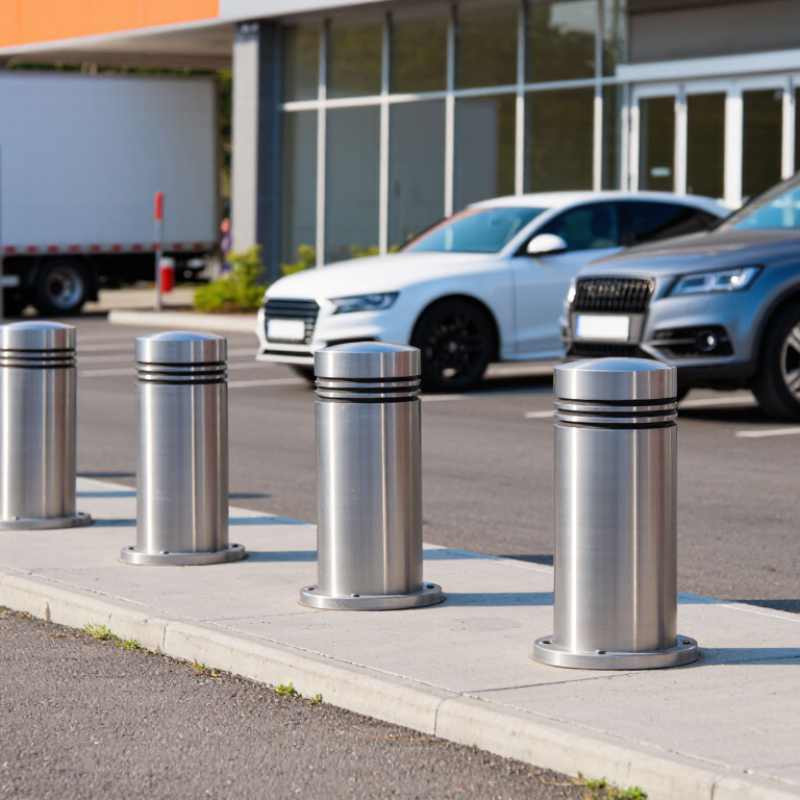
Identify the Purpose and Conditions of the Parking Area
Before choosing steel parking bollards in 2026, define what the area needs them to do. Are they guiding traffic, protecting a storefront, or separating a walkway from reversing vehicles? Count cars, delivery vans, and service trucks during busy periods. Watch where drivers turn and where people actually cross. A site plan can miss that. Small details matter. A bollard placed in a truck’s turning path may become a collision hazard rather than useful protection.
Check local exposure, too.
NHTSA’s 2022 Traffic Safety Facts reported 7,522 pedestrian deaths in U.S. traffic crashes; this national figure is not a parking-lot risk estimate, but it underscores why pedestrian routes deserve attention.
For weather planning, NOAA’s 1991–2020 U.S. Climate Normals provide local temperature and precipitation records. Use them to consider freeze-thaw cycles, standing water, and road salt, which can affect steel finishes and maintenance needs. Note snowplow routes and drainage points on site. A corrosion-resistant finish may help, but it cannot compensate for poor drainage. Revisit your assumptions after observing the lot in rain or at peak traffic; one inspection is rarely enough.

Compare Bollard Designs, Steel Grades, and Protective Features
A useful comparison starts with the site, not the bollard’s appearance. Fixed steel bollards suit entrances that need a permanent boundary, while removable models help when service vehicles need occasional access. Surface-mounted designs can simplify installation on existing concrete, but the slab must be sound and thick enough for the anchors. Check the manufacturer’s load and installation data. Looks are only part of the choice.
Steel grade affects strength and corrosion resistance, but thicker steel alone does not guarantee better protection. For coastal air or areas exposed to de-icing salts, compare galvanized finishes, suitable coatings, and maintenance requirements. Ask how the post, base plate, and fasteners resist corrosion together. That detail matters. Protective features also shape everyday use: reflective bands improve visibility at dusk, rounded caps reduce sharp edges, and sleeves can make scuffs easier to address. For vehicle-impact protection, confirm that the complete bollard system has been tested for the intended application; a heavy post is not proof of a rated barrier. Measure spacing against door swings, pedestrian routes, and the widest vehicle expected. A small mistake is easy to make: selecting a finish for appearance, then discovering it needs frequent touch-ups. The right balance depends on exposure, access needs, and upkeep.
Choose Bollard Height, Diameter, Spacing, and Installation Method
Choose height for the people using the site, not just the vehicle you want to stop. A 30–36-inch bollard is often visible to drivers and pedestrians, but parked cars, snow, and planters can hide it. Check sightlines from a seated position, too. Small detail. Diameter alone does not prove impact strength; ask for tested performance and foundation requirements.
Spacing must balance vehicle control with clear pedestrian access. NACTO’s Urban Street Design Guide gives a typical bollard spacing range of 3–5 feet. Measure the clear gap, not just center-to-center distance, and check the route against the U.S. Access Board’s 32-inch minimum clear-width guidance. Bicycles, mobility devices, and maintenance carts need room to pass. The numbers can feel awkward on a narrow sidewalk.
Choose the installation method after checking soil, pavement depth, drainage, and buried utilities. Surface-mounted units can suit some existing slabs, while embedded bollards need a footing designed for site conditions and expected loads. ASTM F3016/F3016M evaluates low-speed impact performance at 10, 20, and 30 mph; use test results to compare protection, not diameter alone. A site-specific review matters. I would still recheck the layout after a full-scale mock-up.
Check Visibility, Weather Resistance, and Applicable Standards
A practical site check starts from the driver’s eye level, not a product sheet. Check at dusk. Look for clear contrast against paving, walls, and parked vehicles, then view the bollards in rain and headlight glare. Reflective bands can improve visibility, but their height and placement matter. Keep them unobstructed by landscaping, snow, or open vehicle doors. A bright finish may still disappear against a bright sign or façade.
Weather resistance depends on the site. Salt finds seams. For coastal or winter locations, compare corrosion protection, steel thickness, drainage details, and the finish’s repair requirements. Scratches around the base can expose steel, so inspect how the bollard will be anchored and maintained. There is no perfect coating; a durable choice still needs periodic checks.
Applicable standards vary by location and use. Check local building, accessibility, fire-access, and traffic requirements before selecting dimensions, spacing, color, or impact performance. Ask for current test documentation where a rated product is specified, and confirm that installation conditions match the test. A rating alone does not prove suitability for every site. Record the chosen requirements and verify them with the project authority.
How to Choose Steel Parking Bollards in 2026? - Check Visibility, Weather Resistance, and Applicable Standards
| Selection Factor | What to Check | Practical Guidance | Standards and Verification |
|---|---|---|---|
| Intended function | Whether the bollard is for visual guidance, pedestrian separation, vehicle access control, or vehicle impact resistance. | Match the bollard and its foundation to the actual risk. A standard parking bollard should not be assumed to stop a moving vehicle. | If impact resistance is required, specify a tested barrier system and installation appropriate to the site—not just a steel post. |
| Visibility in daylight | Contrast with the surroundings, finish color, and visibility from driver approach angles. | Use a contrasting finish where the post could blend into paving, walls, landscaping, or parked vehicles. Check visibility in the installed setting. | Follow applicable local site, road-authority, or facility specifications for colors and markings. |
| Nighttime visibility | Reflective bands, reflective sheeting, lighting, and the condition of those features over time. | Consider reflective markings where vehicles approach in low light. Keep markings clean and replace damaged or faded material. | For public-road applications, check the relevant road authority requirements and the current MUTCD where applicable in the United States. It does not automatically govern every private parking area. |
| Steel and corrosion protection | Steel grade, coating type, coating coverage, and protection at welds, cut edges, and the base. | Hot-dip galvanizing provides a zinc coating; a compatible topcoat may be considered for added color or protection. Confirm coating repair procedures for installation damage. | ASTM A123/A123M covers zinc coatings applied by hot-dip galvanizing to iron and steel products. It does not by itself guarantee a specific service life in every environment. |
| Coastal or de-icing-salt exposure | Salt exposure, moisture retention, drainage, and the suitability of the steel and coating system. | Specify a corrosion-protection system for the actual exposure. Stainless steel grade 316 generally offers better resistance to chloride exposure than grade 304, but neither choice eliminates the need for suitable design and maintenance. | Ask the supplier for material and coating documentation, and have the specification reviewed for the site’s exposure conditions. |
| Dimensions and placement | Post height, diameter, wall thickness, spacing, setback, and foundation dimensions. | There is no single size suitable for every site. Set dimensions and spacing based on vehicle paths, pedestrian routes, visibility, required protection, and the bollard manufacturer’s installation details. | Check local building, fire-access, accessibility, and site-plan requirements before setting out the bollards. |
| Foundation and installation | Embedment or anchor design, concrete condition, underground utilities, and drainage around the base. | Use the installation method specified for the selected bollard. Confirm that the substrate and foundation can support the intended use; avoid placing posts where water can collect around the base. | For crash-rated systems, installation details are part of the tested system’s performance and should be followed as specified. |
| Fixed, removable, or retractable type | How often access must be opened, who controls it, and the maintenance needed for moving parts. | Choose fixed posts for permanent separation. Consider removable or retractable designs where authorized vehicle access is needed, and plan for locks, keys, drainage, and routine inspection. | Check local emergency-access and site-security requirements before choosing an access-control arrangement. |
| Accessibility and pedestrian clearance | Clear width of accessible routes, detectable placement, and potential obstruction of doors, ramps, or crossings. | Locate bollards so they do not obstruct required routes or create avoidable trip and maneuvering hazards. Review the complete route, not just the post location. | Where applicable, check the ADA Standards and relevant state or local accessibility requirements; confirm the requirements for the specific site and jurisdiction. |
| Impact-rating claims | Test rating, tested configuration, foundation, installation conditions, and the exact product being supplied. | Do not rely on appearance, wall thickness, or a general “heavy-duty” description as proof of crash performance. Request documentation for the complete system and confirm it matches the proposed installation. | ASTM F2656/F2656M is a vehicle-barrier crash-test method and classification specification. Its relevance depends on the project; it is not a general requirement for every parking bollard. |
| Inspection and maintenance | Loose anchors, corrosion, coating damage, faded reflective material, damaged caps, and water ingress. | Set a routine inspection schedule based on exposure and use. Repair coating damage and replace worn visibility features promptly. | Follow the manufacturer’s maintenance instructions and any applicable owner, road-authority, or local requirements. |
Note: Requirements vary by location and application. Confirm current local codes, accessibility rules, road-authority specifications, and project engineering requirements before purchase and installation.
Evaluate Cost, Maintenance Needs, and Supplier Quality
When choosing steel parking bollards in 2026, compare the installed cost, not just the price per post. Include anchors, concrete work, coatings, freight, and replacement access. A low-cost unit can become expensive if its finish fails early or its base is difficult to repair. The NACE IMPACT study estimated global corrosion costs at US$2.5 trillion annually, or 3.4% of global GDP. That figure covers many industries, not bollards alone, but it shows why corrosion protection deserves attention.
Match the finish to the site. Road salt, coastal air, frequent impacts, and standing water can all increase maintenance demands. Ask suppliers for coating specifications, steel grade documentation, weld inspection records, and clear installation guidance. Check whether replacement parts and warranty support will remain available. Compare those details across written quotations. A polished brochure is not proof of consistent production. I would also ask how defects are handled; that answer can be revealing.
Tips: Request a sample finish and inspect edges, welds, and drainage details. Set a simple inspection schedule for chips, rust, loose anchors, and impact damage. Record repair time and costs. A spreadsheet is enough, though it may feel overly fussy at first. NACE reported that established corrosion-control practices can save 15–35% of corrosion costs, but actual savings depend on the asset and maintenance plan.