How to Choose the Right Photoelectric Sensors for Your Application?
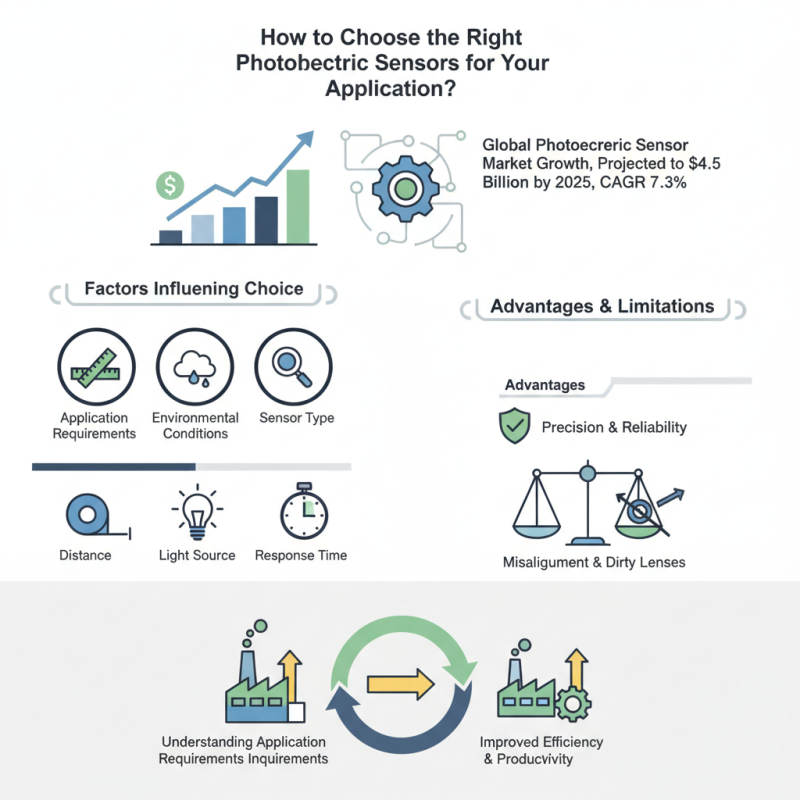
Photoelectric Sensors play a crucial role in modern automation and industrial applications. According to a report by Markets and Markets, the global photoelectric sensor market is projected to reach $4.5 billion by 2025, growing at a CAGR of 7.3%. This growth reflects the rising demand for efficient sensing technologies across various sectors. Industries are increasingly relying on these sensors for their precision and reliability.
Selecting the right photoelectric sensor is not a simple task. Various factors influence the choice, including application requirements, environmental conditions, and sensor type. For instance, sensors must be evaluated based on distance, light source, and response time. Finding a suitable sensor is essential for optimal performance.
Despite their advantages, photoelectric sensors can have limitations. Misalignment or dirty lenses may affect functionality. Therefore, understanding the application requirements is vital. Decisions should be based on well-informed criteria. This careful selection process can lead to improved efficiency and productivity. Balancing these considerations is key to harnessing the full potential of photoelectric sensors in any application.
Understanding the Basics of Photoelectric Sensors
Photoelectric sensors are vital in industrial automation. They detect the presence or absence of objects using light beams. Understanding their basics is crucial for choosing the right sensor for your needs.
These sensors come in different types: through-beam, retro-reflective, and diffuse. Each type has its unique characteristics. For example, through-beam sensors offer a longer detection range. However, they may require precise alignment. Retro-reflective sensors are easier to install, but they can be affected by obstacles. Thus, choosing the correct type depends on your application and the environment.
When selecting a photoelectric sensor, consider the operating distance and object size. Analyze your specific needs. For instance, if you are detecting small objects, a sensor with high sensitivity is essential. Reflect on your installation space, as some sensors require more room than others. Knowing your environment, such as lighting conditions, also matters. These factors will help in making an informed decision.
Comparison of Different Types of Photoelectric Sensors
Different Types of Photoelectric Sensors and Their Applications
When selecting photoelectric sensors, understanding the types available is crucial. There are four main types: through-beam, retro-reflective, diffuse reflective, and fiber optic. Through-beam sensors emit a beam of light and detect its interruption. They work well for long distances and in dusty conditions. Retro-reflective sensors use a reflective surface to bounce back light. They are good for detecting objects with varying colors. Diffuse reflective sensors are ideal for detecting targets that are close in range. Finally, fiber optic sensors are flexible and can be used in tight spaces.
Tips: Assess the environment before choosing a sensor type. Dust, moisture, and temperature can affect performance. Unexpected factors may lead to sensor malfunction. Think about the specific application, as not all sensors fit every scenario. Even minor changes can impact accuracy.
Consider installation as well. Some sensors have complex setups. Others are straightforward. The ease of installation can save time and reduce errors. If a sensor is challenging to install, you may need additional resources. Reflect on the trade-offs between sensor complexity and application needs. Each choice comes with its own set of challenges that may not be apparent initially.
Key Factors to Consider When Selecting Photoelectric Sensors
Choosing the right photoelectric sensor can be challenging. Consider the application area and specific needs. Sensors come in various types: diffuse, retro-reflective, and through-beam. Each type serves unique purposes. Understanding the environment is crucial. Dust, humidity, or vibrations can affect sensor performance.
Tips: Always check the IP rating. Higher ratings mean better protection against dust and water. It’s essential for harsh environments.
Next, evaluate the distance and range requirements. A sensor with a limited range may not work effectively in large spaces. Consider the required response time. For fast-moving objects, a quicker sensor is needed. Sometimes, trade-offs are necessary. A sensor with high sensitivity may be less durable.
Tips: Test different models in your setting. Real-world conditions may reveal flaws not seen in specifications. Always gather feedback from installation teams. They can provide insights into practical challenges.
Evaluating Sensor Specifications for Optimal Performance
When selecting photoelectric sensors, sensor specifications play a critical role in performance. For instance, sensing range is paramount. Some sensors operate effectively within 0.1 to 10 meters. However, the environment can greatly influence this range. Dust, moisture, and light conditions can affect accuracy. Data from industry reports indicate that nearly 30% of sensor failures are due to improper range selection.
Sensitivity is another aspect to consider. Sensors with high sensitivity can detect even minute changes in light. Yet, overly sensitive sensors may result in false readings. A balance is crucial. Reports reveal that 25% of users experience issues related to sensor sensitivity adjustments. Factors such as installation position and ambient light can also contribute to these problems.
Lastly, response time should not be overlooked. Fast response times enhance operational efficiency. A response time of less than 2 milliseconds is common in many applications. However, faster is not always better. Sensors may require fine-tuning to prevent errors. Reflecting on these specifications leads to more informed decisions. Understanding these aspects can lead to optimal sensor performance in varying applications.
Best Practices for Integrating Photoelectric Sensors in Your System
When integrating photoelectric sensors into a system, consider the environment. Dust, moisture, and extreme temperatures can affect performance. Ensure the chosen sensors are rated accordingly. For instance, a sensor used in a factory setting may need a higher IP rating than one used in a clean office.
Proper positioning is crucial. Mount the sensors at the correct height and angle for accurate detection. Test different placements to find the most effective spot. This may require some trial and error. Adjusting the setup can lead to better performance over time.
Wiring and connectivity are often overlooked. Use quality cables to prevent signal interference. Ensure connections are secure. Troubleshooting can become a lengthy task if wiring issues arise. It’s wise to have a backup plan and extra sensors on hand for quick replacements.
How to Choose the Right Photoelectric Sensors for Your Application?
| Sensor Type | Sensing Range | Response Time | Output Type | Environmental Rating |
| Through-Beam | 0.1 to 25 m | < 1 ms | NPN/PNP | IP67 |
| Retroreflective | 0.1 to 15 m | < 2 ms | NPN/PNP | IP65 |
| Diffuse Reflective | 0.05 to 2 m | < 1.5 ms | NPN/PNP | IP67 |
| Laser Sensor | 0.1 to 60 m | < 0.5 ms | NPN/PNP | IP66 |