China Top 10 Eyeglass Showcase Manufacturers for Global Buyers
Choosing the right Chinese supplier requires more than comparing prices or viewing polished catalog images. An Eyeglass Showcase must protect frames, support easy browsing, and fit the store’s layout. A countertop display for a compact boutique has different needs from a floor-standing unit for a large retail space. Details matter.
This guide introduces ten manufacturers for global buyers and offers a practical starting point for supplier research. It considers product range, material options, customization, production capabilities, quality checks, and export communication. Buyers can also compare display features such as adjustable shelves, secure locks, integrated lighting, and scratch-resistant surfaces. Ask for dimensions, finish samples, packaging details, and clear photographs before approving an order. No list is perfect. A manufacturer’s stated capabilities may not reflect every project, and product quality can vary between samples and full production runs. That is worth checking.
Use the profiles to identify suppliers that match your product type, budget, and required order volume. Request written specifications and confirm lead times, inspection procedures, and after-sales support directly. If possible, review a physical sample under realistic store lighting. A bright showroom image can hide uneven edges or reflections on glass. Careful verification takes time, but it helps buyers make decisions based on evidence rather than presentation alone.
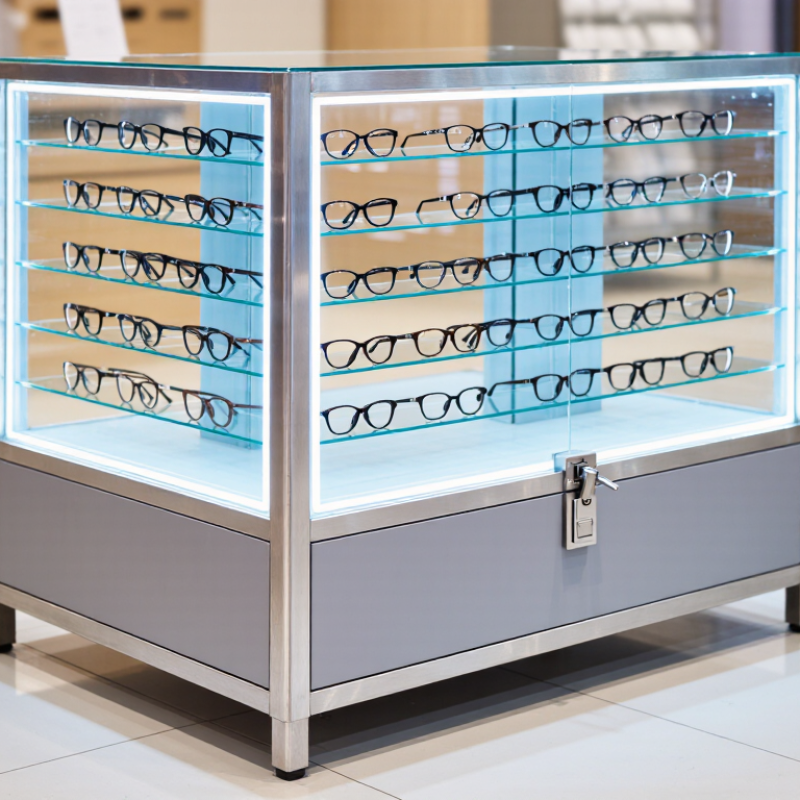
Eyeglass Showcase Types: Wall-Mounted, Countertop, and Freestanding Designs
Global buyers comparing eyeglass showcase manufacturers should match the display type to store traffic, available floor area, and frame range. Grand View Research estimated the global eyewear market at USD 183.36 billion in 2022 and projected an 8.3% compound annual growth rate from 2023 to 2030. That scale makes clear product visibility matters, though the report measures eyewear sales, not showcase performance.
Wall-mounted showcases free floor space and keep frames visible along a bright, uncluttered wall. They suit compact boutiques, but high shelves can make browsing awkward.
Countertop cases place selected frames near checkout, where glass, lighting, and lock access need careful review.
Freestanding units can define a pathway or feature new collections. They also occupy valuable floor area.
Small details matter. Ask manufacturers for material samples, lighting specifications, and drawings showing cable access and shelf spacing. A polished rendering may hide practical issues.
Tips: Test the layout with real frame sizes before ordering. Check reflections under the store’s actual lighting, and confirm that staff can reach every shelf. Not every plan works. Leave enough aisle space for comfortable browsing, even if that means displaying fewer frames.

Core Materials and Safety: EN 12150-1 Toughened Glass and Metal Frames
For an eyeglass showcase, safety starts with the glass specification, not its polished appearance. EN 12150-1:2015 covers thermally toughened soda-lime silicate safety glass, including fragmentation testing and dimensional requirements. Buyers should request traceable test documentation and confirm that the delivered thickness matches the specification. Toughening improves impact performance, but it does not make glass unbreakable. Small details matter.
A broken pane should fragment differently from ordinary annealed glass, yet edge damage can still weaken it. Inspect corners, drilled holes, and cut edges under good light; chips can be easy to miss after installation. Metal frames need equal attention. Check welded joints, fasteners, coating coverage, and contact points where metal meets glass. A rigid frame can concentrate stress if the glazing fit is too tight. Not enough, though.
Material sourcing also deserves scrutiny. The World Steel Association’s World Steel in Figures 2024 reports 1,892.2 million tonnes of crude steel production worldwide in 2023. That scale does not prove a frame is safe or durable; alloy choice, fabrication, and finish matter. Ask suppliers for material specifications and corrosion-resistance test results, especially for humid retail environments. A certificate is useful, but it cannot replace checking the actual showcase, its edges, and its assembly tolerances.
Display Lighting Benchmarks: 3,000–4,000 K and CRI ≥90
For global eyeglass buyers, showcase lighting should make frame colors look credible, not merely bright. A practical design target is 3,000–4,000 K, paired with a color rendering index (CRI) of at least 90. The warmer end can soften metal and tortoiseshell finishes; the cooler end may make clear lenses and pale frames look crisper. Keep the light even across the shelf. A bright hotspot can make one frame appear richer than the same model beside it. Color is the product.
CRI needs context. CIE Publication 13.3-1995 calculates general CRI, Ra, from eight standard test-color samples, so a high score does not describe every hue equally. The Illuminating Engineering Society’s TM-30-20 evaluates 99 color samples and reports fidelity and gamut measures, Rf and Rg. Buyers can request these values alongside CCT and CRI, then inspect frames under the actual display light. Ask for a sample fixture, too. I would still question any specification that lists CRI alone; lens reflections and nearby surface colors can change what shoppers see. A measured benchmark helps, but the final check belongs in the finished showcase.
China Top 10 Eyeglass Showcase Manufacturers for Global Buyers - Display Lighting Benchmarks: 3,000–4,000 K and CRI ≥90
Anonymous buyer-side benchmark matrix for evaluating eyeglass showcase suppliers. The figures below are specification targets or recognized reference requirements, not performance claims about any particular manufacturer.
| No. | Evaluation dimension | Buyer benchmark / target | How to verify | Buyer relevance |
|---|---|---|---|---|
| 1 | Correlated color temperature (CCT) | 3,000–4,000 K | Check the luminaire datasheet and confirm the installed units with a calibrated color meter. | Provides a warm-to-neutral white-light range for presenting frames and lens finishes. |
| 2 | Color rendering index (CRI) | Ra ≥90 | Request the test report or product datasheet stating general CRI (Ra); verify the model and test conditions. | High color-rendering performance helps shoppers assess frame colors more faithfully. |
| 3 | Red color rendering (R9) | Set a project-specific minimum and request the reported R9 value. | Review the full color-rendering report; Ra alone does not specify the saturated-red R9 result. | Supplementary color data can help compare how warm hues and certain finishes appear. |
| 4 | Color consistency between fixtures | Specify a maximum SDCM / MacAdam-step variation in the purchase specification. | Request the manufacturer’s binning or color-consistency data for the quoted LED modules. | Helps reduce visible color differences between adjacent showcases. |
| 5 | Display-plane illuminance | Determine the target lux level through a mock-up and site lighting plan; there is no single universal value for every store. | Measure illuminance at the actual frame display plane after installation, with ambient lighting recorded. | Balances product visibility against glare, reflections, and excessive contrast. |
| 6 | Illuminance uniformity | Define the acceptable minimum-to-average illuminance ratio for the project. | Take a documented grid of lux readings across the display area and calculate Emin/Eavg. | Identifies uneven lighting, dark corners, and distracting hotspots. |
| 7 | Flicker performance | For applicable EU markets, check the relevant ecodesign limits at full load: PstLM ≤1.0 and SVM ≤0.4. | Request test results for the exact light source or control gear and confirm the destination-market requirements. | Supports compliance checks and helps buyers compare temporal-light-artifact performance. |
| 8 | Optics and beam control | Specify beam distribution, shielding, and aiming needs for the showcase layout; confirm by sample installation. | Review photometric files or beam data where available, then inspect reflections on actual lenses and glass. | Good control helps direct light onto frames while limiting unwanted glare and spill. |
| 9 | Electrical and photobiological safety | Request evidence against applicable luminaire safety requirements, including IEC 60598-1 where relevant, and assess photobiological safety under IEC 62471 as applicable. | Check current test reports or certificates for the exact luminaire configuration and target market. | Supports technical due diligence; applicable standards and certification routes depend on market and product design. |
| 10 | Ingress protection and installation environment | Specify the required IP rating based on the installation location. IP20, for example, does not provide water protection. | Verify the rated IP code in product documentation and confirm it matches the showcase location and cleaning conditions. | Prevents selecting an enclosure rating unsuitable for the expected environment. |
Note: This is a supplier-evaluation checklist, not a ranked list of ten named manufacturers. Numeric targets identified as project-specific should be agreed in the specification and validated using the final showcase, light source, controls, and installation conditions.
China’s Top 10 Manufacturers: Compare Products, MOQ, Lead Time, and Exports
Comparing China’s eyeglass showcase manufacturers starts with the product itself. Options may include countertop cases, wall-mounted displays, rotating stands, and lockable cabinets. Check the frame material, panel thickness, lighting, and finish against your store layout. Details matter. Ask for close-up photos and a sample to assess hinges, edges, and how lenses sit on the shelves. A polished image cannot show every flaw.
Minimum order quantities vary with design and customization. A standard acrylic stand may have a lower MOQ than a custom cabinet with tailored dimensions or lighting. That varies. Request separate quotes for samples, tooling, and bulk production, since a low unit price may exclude setup costs. Lead times should distinguish sample approval, manufacturing, and packing; confirm each stage in writing. Custom work can take longer, especially when finishes or components need approval. Not always.
For exports, compare carton protection, labeling, packing lists, and the supplier’s experience preparing shipments for your destination. Ask how fragile panels are cushioned and whether replacement parts can be packed with the order. One overlooked point: a short production estimate does not include transit time or delays at handover. Compare the full schedule and landed cost, not just the factory price. Some details may change after a sample review, so leave room for adjustment.
Global Buyer Checks: ISO 9001:2015 Quality Systems and Incoterms® 2020
When evaluating eyeglass showcase manufacturers, treat ISO 9001:2015 as evidence of a managed quality system, not a promise of flawless products. Ask for the current certificate, issuing body, validity dates, and scope covering the relevant manufacturing work. Then compare it with production records. A batch inspection sheet should list dimensions, glass thickness, edge finish, lighting checks, and packaging condition. Look closely. A 1,200 mm counter unit may pass visual review, yet its door alignment can shift after repeated opening.
Incoterms® 2020 should appear in the quotation and purchase contract alongside a precise named place, such as a port or warehouse. Clarify whether the price includes export clearance, main carriage, insurance, or unloading; responsibilities depend on the selected rule. “Freight included” is not enough. For fragile glass panels, ask who arranges cargo insurance, how crates are protected, and when transport risk transfers.
Before a large order, request a sample crate or a small pilot shipment. Check its corner protectors, moisture barrier, and process for replacing scratched panels. Paperwork matters. Still, a certificate and tidy records may not reveal every factory weakness. Where practical, verify one production lot through a live inspection or a detailed video review. That extra check can expose gaps before several units are packed and shipped.
Incoterms® 2020: Rules by Transport Applicability
For global eyewear buyers, Incoterms® 2020 includes seven rules for any mode or modes of transport and four rules specifically for sea and inland waterway transport.
Use the rule that fits the shipment method and clearly agree on delivery obligations, costs, and risk transfer with your supplier.