What Is a China Moisture Proof FIBC Manufacturer?
A China Moisture Proof Fibc Manufacturer produces flexible intermediate bulk containers designed to protect powders, granules, and sensitive materials from humidity. These bags usually combine woven polypropylene fabric, coated surfaces, liners, and carefully sealed closures. The objective is practical: reduce moisture entry during storage, loading, and ocean transport.
Market demand is expanding. Mordor Intelligence estimates the global FIBC market at approximately USD 6.19 billion in 2024, with continued growth projected through 2029. Different reports provide different figures, because their market definitions and regional coverage vary. That limitation deserves attention. Still, the trend is clear: manufacturers increasingly need packaging that supports cleaner handling and more stable product quality.
A capable supplier should understand moisture transmission, liner selection, fabric coating, and filling conditions. ISO 21898 provides requirements for packaging made from flexible intermediate bulk containers, including construction and performance considerations. In practice, buyers should request test records, production photos, material specifications, and batch traceability. A reliable China Moisture Proof Fibc Manufacturer should also explain how its bags perform after folding, stacking, and long-distance shipment. Small details matter. A loose liner, weak seam, or poorly fitted discharge spout can undermine an otherwise strong bag. Moisture protection is not only a marketing phrase. It requires verified materials, controlled production, and honest communication about limitations. No container is perfect. Real performance depends on the product, climate, storage time, and transport environment.
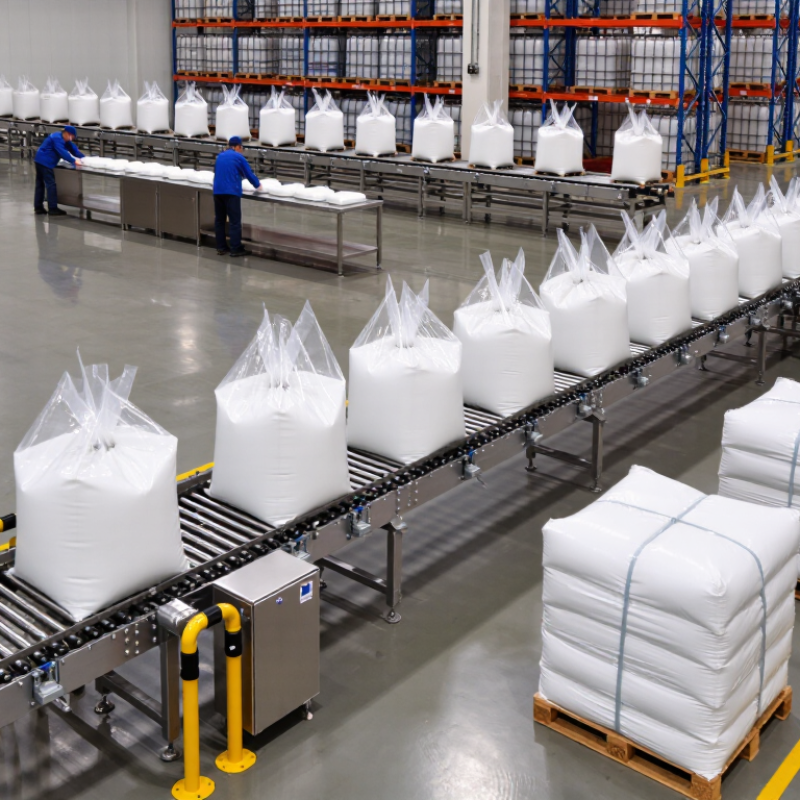
Definition and Role of a China Moisture-Proof FIBC Manufacturer
A China moisture-proof FIBC manufacturer designs and produces flexible intermediate bulk containers that help protect dry materials from humidity during storage and transport. Its role extends beyond sewing fabric panels. It involves selecting suitable woven polypropylene, coating layers, liners, closures, lifting loops, and moisture-control features for each application.
Experienced manufacturers usually begin with a practical review of the material, filling method, storage period, and transport environment. A liner may reduce moisture exposure, while coated fabric can add another protective barrier. Strong seams matter when bags hold dense powders or granules. Production teams should inspect fabric weight, seam strength, dimensions, and lifting performance through documented quality procedures.
Testing is important, but test results never tell the whole story. Real warehouses may have temperature changes, rough handling, condensation, or unexpected stacking pressure. A dependable manufacturer records production data and communicates limitations clearly. It should also provide samples for evaluation before large-scale production.
Small details can prevent large losses. However, moisture protection is not automatically permanent. Poor storage, damaged liners, or incorrect filling can weaken the intended performance. Manufacturers need to review failures honestly and adjust materials, construction, or instructions. This practical attitude shows experience, technical knowledge, and responsibility.
What Is a China Moisture Proof FIBC Manufacturer? - Definition and Role of a China Moisture-Proof FIBC Manufacturer
| Data Dimension | Definition and Technical Meaning | Role of a China Moisture-Proof FIBC Manufacturer | Relevant Practical Indicators |
|---|---|---|---|
| Core Definition | A China moisture-proof FIBC manufacturer produces flexible intermediate bulk containers designed to reduce the entry or transmission of moisture during filling, storage, handling, and transport. | The manufacturer combines woven polypropylene construction with protective features such as coated fabric, polyethylene liners, or barrier-film solutions to meet the moisture-control needs of bulk materials. | Moisture resistance Bulk packaging Custom design |
| Primary Material | Most FIBCs use woven polypropylene fabric because it provides a high strength-to-weight ratio. Moisture protection is normally added through fabric coating, an inner liner, or a laminated structure. | The manufacturer selects compatible materials according to the product's sensitivity to humidity, required filling method, discharge method, and transportation conditions. | Woven PP PE liner Laminated fabric |
| Moisture-Protection Structure | Moisture protection can be provided by coated woven fabric, a form-fitted liner, a loose liner, or a multilayer barrier film. The correct structure depends on the required level of protection. | The manufacturer develops the bag structure and sealing details to limit moisture ingress through the body, seams, filling inlet, discharge outlet, and closure areas. | Coated fabric Form-fit liner Heat sealing |
| Protection Scope | Moisture-proof FIBCs are intended to help protect dry bulk products from humidity, condensation, and incidental water exposure. They are not automatically equivalent to waterproof containers for prolonged outdoor exposure or immersion. | The manufacturer must define the intended protection level clearly and recommend suitable storage, palletizing, covering, and transportation practices. | Humidity control Condensation reduction Not immersion-proof by default |
| Typical Applications | Moisture-resistant FIBCs are commonly used for dry powders, granules, minerals, chemicals, agricultural products, construction materials, and other non-liquid bulk goods that may be affected by humidity. | The manufacturer adapts the container to product flowability, bulk density, dust-control requirements, filling equipment, discharge equipment, and storage duration. | Powders Granules Minerals Agricultural goods |
| Load Capacity | FIBCs are commonly specified by safe working load, often expressed in kilograms or tonnes. The permissible load depends on fabric strength, lifting loops, seams, construction, and testing. | The manufacturer designs the bag for the required safe working load and verifies performance through applicable strength, lifting, and repeated-use assessments. | SWL Safety factor Lifting-loop strength |
| Moisture-Sensitive Product Compatibility | Products that cake, clump, degrade, lose flowability, or change quality when exposed to humidity may require a liner or a higher moisture-barrier construction. | The manufacturer evaluates the product, expected exposure, filling temperature, storage conditions, and required shelf life before recommending the structure. | Caking risk Shelf life Flowability |
| Seam and Closure Design | Seams, spouts, top closures, and liner connections can become potential paths for moisture entry if they are poorly designed or improperly sealed. | The manufacturer selects sewing, taping, welding, or heat-sealing methods according to the required containment and barrier performance. | Stitched seams Welded liner Secure closure |
| Dust and Containment Control | A properly designed liner and seam system can also help limit product leakage and dust release, particularly for fine powders. | The manufacturer configures liner fit, spout dimensions, closure systems, and seam specifications to support clean handling and controlled discharge. | Fine-powder containment Liner fit Dust reduction |
| Testing and Quality Control | Quality control may include fabric inspection, dimensional checks, seam-strength testing, lifting tests, visual inspection, liner integrity checks, and verification against agreed specifications. | The manufacturer establishes production controls, retains inspection records, and provides test documentation or samples when required by the buyer or application. | Seam strength Lifting test Liner integrity |
| Relevant Standards | ISO 21898 is widely used for packaging requirements for non-dangerous goods in FIBCs. Additional testing methods may be selected for fabric, seams, liners, moisture transmission, or product-specific performance. | The manufacturer identifies the applicable standard, test method, and acceptance criteria instead of making a general moisture-proof claim without defined technical evidence. | ISO 21898 Agreed test methods Traceable records |
| Customization Capability | FIBCs can be customized by dimensions, top and bottom construction, liner type, loop arrangement, fabric coating, printing area, and discharge configuration. | The manufacturer converts packaging requirements into a documented specification and supplies samples or prototypes for fit and process validation. | Dimensions Inlet/outlet Liner configuration |
| Storage and Transport Guidance | Even moisture-resistant FIBCs should normally be stored under cover, away from standing water, excessive humidity, sharp objects, direct sunlight, and damaging heat sources. | The manufacturer should communicate handling limits, stacking guidance, liner protection requirements, and recommended conditions for preserving bag performance. | Covered storage Dry environment UV protection |
| Buyer Evaluation Criteria | A buyer should compare the technical specification, moisture-protection structure, safe working load, test evidence, production consistency, lead time, and packaging suitability. | A qualified manufacturer provides clear documentation and aligns the FIBC design with the buyer's material, equipment, logistics route, and storage conditions. | Specification clarity Sample approval Quality consistency |
| Overall Business Role | A China moisture-proof FIBC manufacturer is not only a bag producer; it is a packaging engineering and supply partner for moisture-sensitive dry bulk materials. | Its role includes material selection, structural design, manufacturing, inspection, customization, documentation, and technical support for safer and more reliable bulk handling. | Engineering support Manufacturing Quality assurance |