What Are the Best Electric Pallet Jacks from China?
Choosing the right Electric Pallet Jacks from China requires more than comparing prices on a supplier page. Warehouse conditions change everything. A compact 1.5-ton model may work well in narrow aisles, while a heavier unit suits busy loading docks. Battery type, charging time, fork length, lift height, and turning radius deserve careful attention. So does the operator’s daily routine.
This guide examines practical options from established Chinese manufacturers and exporters. It considers frame construction, motor performance, control-handle design, braking response, and battery access. Real use matters here. A pallet jack that moves smoothly across a clean warehouse may struggle on cracked concrete or slightly uneven floors. Small details become expensive problems.
Supplier reliability also needs close inspection. Product documentation should clearly state rated capacity, operating temperature, charging requirements, and recommended maintenance intervals. Factory audits, sample testing, warranty terms, spare-parts access, and responsive technical support can reveal more than attractive photographs. Independent inspection remains sensible before a large order. Marketing claims are not always complete.
There is no universal best model. That answer would be convenient, but inaccurate. The strongest choice depends on load frequency, aisle width, floor quality, labor conditions, and available service support. Some buyers may prefer lithium batteries for faster charging and lower routine maintenance. Others may choose lead-acid systems because replacement options are familiar and initial costs are lower.
The following overview compares leading categories, useful specifications, and purchasing considerations. It aims to support a practical decision, not simply promote the cheapest offer. Performance should be verified under real warehouse conditions. That step is often overlooked.
What Are Electric Pallet Jacks and How Do They Work?
What Are the Best Electric Pallet Jacks from China?
What Are Electric Pallet Jacks and How Do They Work?
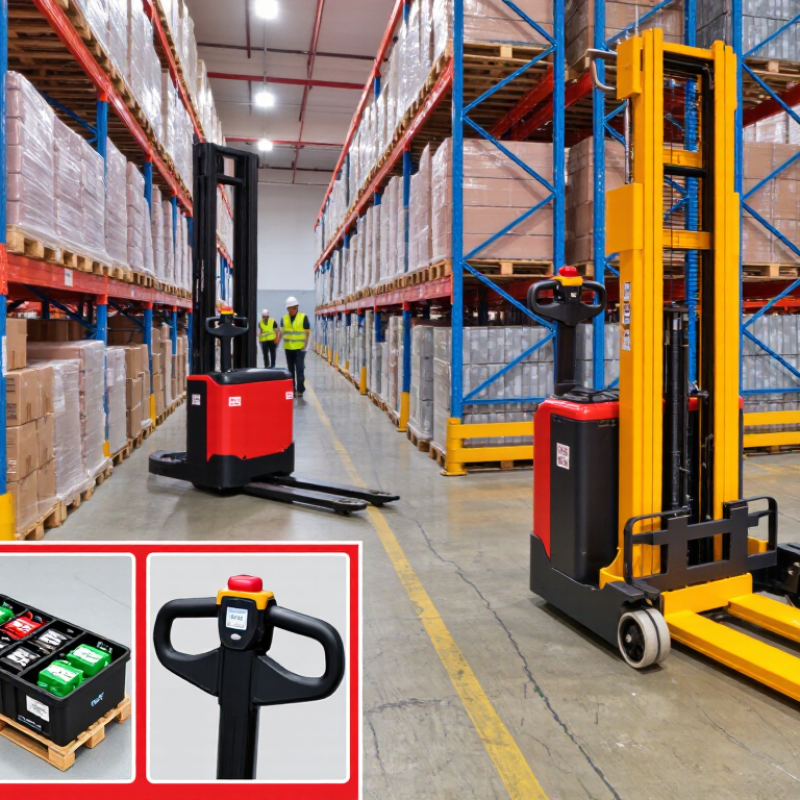
An electric pallet jack moves palletized loads with battery power instead of manual pumping. Its battery feeds a traction motor through an electronic controller. The motor turns the drive wheel, while a hydraulic pump raises the forks. A tiller handle controls travel, lifting, lowering, braking, and emergency stopping. Operators usually walk behind the machine, although some higher-capacity models include a standing platform. It is simple. The details are not.
When selecting equipment from China, check the rated capacity, battery chemistry, charging time, turning radius, and brake response. A 2,000-kilogram capacity rating does not guarantee safe performance on every floor. MHI’s 2024 Annual Industry Report found that 55% of supply-chain professionals planned to increase technology and innovation investment. That trend supports wider automation, but it does not replace practical testing. The International Energy Agency reported a 14% fall in global lithium-ion battery pack prices during 2023, which may improve battery affordability. Battery quality still varies.
Look for documentation aligned with ISO 3691-5 or equivalent safety requirements. Ask for load-test records, controller protection details, and replacement-part availability. Test the jack with a real pallet, not only an empty machine. That detail matters. In my experience, poor wheel traction becomes obvious near ramps and cold storage areas. Some specifications also appear optimistic. A careful buyer should question them.
What Are the Best Electric Pallet Jacks from China? - What Are Electric Pallet Jacks and How Do They Work?
An electric pallet jack is a powered material-handling vehicle used to lift and move palletized loads. A rechargeable battery supplies electricity to a drive motor for travel and, depending on the configuration, a hydraulic or electric lifting system for raising the forks. The following comparison uses representative specifications commonly available in China-manufactured electric pallet jack configurations; exact specifications vary by supplier and configuration.
| Best-Fit Profile | Typical Rated Capacity | Typical Fork Length | Lift Range | Battery Configuration | Travel Speed | Typical Operating Time | Charging Characteristics | How It Works | Recommended Application |
|---|---|---|---|---|---|---|---|---|---|
| Compact Walkie Electric Pallet Jack | 1,200–1,500 kg | 800–1,150 mm | 75–120 mm | 24 V, 40–60 Ah lead-acid or lithium-ion battery | 3.5–4.5 km/h | Approximately 2–4 operating hours per charge, depending on load and duty cycle | Integrated charger is common; lithium-ion versions generally support opportunity charging | The operator controls travel and lifting from the tiller. The drive motor turns the powered wheel, while a hydraulic pump raises the forks. | Small warehouses, retail back rooms, narrow aisles, and short-distance pallet movement |
| Standard Walkie Electric Pallet Jack | 1,500–2,000 kg | 1,150–1,220 mm | 80–125 mm | 24 V, 60–100 Ah lead-acid or lithium-ion battery | 4.5–5.5 km/h | Approximately 3–6 operating hours per charge | External or onboard charger; charging time commonly ranges from 6–10 hours for lead-acid batteries | A controller regulates power from the battery to the traction motor. A hydraulic or electro-hydraulic unit lifts the forks when the lift control is activated. | General warehouse operations, loading docks, food distribution, and daily pallet transport |
| Long-Fork Electric Pallet Jack | 1,500–2,000 kg | 1,500–1,800 mm | 80–125 mm | 24 V, 80–120 Ah battery | 4.0–5.0 km/h | Approximately 3–5 operating hours per charge | Requires adequate charging space; lithium-ion versions reduce routine charging downtime | Powered travel moves the machine beneath the load, while extended forks support two pallets or unusually long pallets when the load is properly balanced. | Long pallets, construction materials, timber products, and handling two standard pallets in a line |
| Platform Rider Electric Pallet Jack | 2,000–2,500 kg | 1,150–1,220 mm | 80–125 mm | 24 V, 160–210 Ah lead-acid or lithium-ion battery | 6.0–9.0 km/h | Approximately 5–8 operating hours per charge | External industrial charger is typical; battery ventilation and charging procedures are important for lead-acid systems | The operator rides on a foldable or fixed platform. A traction motor provides higher travel efficiency over longer distances, while powered lift raises the forks. | Large distribution centers, cross-dock facilities, and frequent long-distance horizontal transport |
| Electric Pallet Jack with Initial Lift | 1,500–2,000 kg | 1,150–1,220 mm | 80–800 mm | 24 V, 80–150 Ah battery | 4.5–6.0 km/h | Approximately 4–7 operating hours per charge | Charging requirements depend on battery chemistry; initial-lift operation increases energy consumption compared with standard low-lift units | A stronger lifting circuit raises both the forks and the chassis to provide temporary ground clearance, allowing the machine to cross small thresholds or uneven floor sections. | Uneven transitions, truck loading, pallet transport over ramps, and occasional low-level work positioning |
| Stainless-Steel or Washdown Electric Pallet Jack | 1,500–2,000 kg | 1,150–1,220 mm | 80–125 mm | 24 V, 60–100 Ah sealed battery system | 3.5–5.0 km/h | Approximately 3–6 operating hours per charge | Sealed electrical components and compatible charging equipment are required; the battery compartment must follow the supplier’s washdown instructions | Operation is the same as a conventional electric pallet jack, but corrosion-resistant materials, sealed controls, and protected electrical components improve resistance to moisture and cleaning chemicals. | Food processing, beverage handling, cold rooms, pharmaceutical logistics, and hygienic environments |
| Semi-Automated or Remote-Assisted Pallet Jack | 1,500–2,000 kg | 1,150–1,220 mm | 80–125 mm | 24 V or 48 V lithium-ion battery, commonly 60–200 Ah | 3.0–6.0 km/h | Approximately 5–10 operating hours per charge, depending on automation functions | Battery management system, onboard diagnostics, and opportunity charging are common in higher-specification configurations | Sensors, programmable controls, and wireless commands assist with travel or route-following. The operator or warehouse-control system remains responsible for safe operation and load handling. | Repetitive transport routes, high-volume warehouses, and operations preparing for warehouse automation |