What Is the Best Double Door Manufacturer in China?
Choosing the best Double Door manufacturer in China is not simply a matter of comparing prices. A glossy catalog can hide uneven finishes, weak packaging, or hardware that feels stiff after repeated use. The right supplier depends on your building, opening size, climate, budget, and installation plan. One manufacturer may excel at custom timber doors, while another is better equipped for aluminum or steel systems.
Architect Louis Sullivan’s phrase, “Form ever follows function,” offers a useful principle for evaluating a Double Door. Appearance matters, but so do smooth operation, secure hinges, accurate dimensions, and dependable seals. This guide compares manufacturers through practical factors: material options, production consistency, customization, quality checks, delivery support, and communication. Ask for clear specifications, finish samples, and recent project references. If possible, inspect a finished sample and test its movement yourself. A door should open evenly, meet cleanly at the center, and feel solid without forcing the handle.
Small details matter. They can be overlooked. Factory visits and independent inspections may reveal useful information, but neither guarantees a perfect order. A sample may also differ from a full production run. That deserves attention. This guide will not name one company as the universal winner. Instead, it will help buyers compare Chinese manufacturers against their project requirements and identify questions worth asking before placing an order. The best choice is the supplier that can demonstrate consistent workmanship, explain its specifications clearly, and respond responsibly when problems arise.
Understanding Double Door Manufacturers in China
Understanding Double Door Manufacturers in China starts with separating factory capability from sales claims. A manufacturer may produce steel, aluminum, or timber doors, but its testing equipment and process controls can differ substantially. Ask for drawings, material specifications, sample results, and inspection records for the exact model you plan to order. Details matter.
China’s construction market offers useful context, not a direct measure of door sales. The National Bureau of Statistics reported that construction enterprises completed RMB 31.6 trillion in output value in 2023, up 5.8% year over year. This broad industry figure suggests substantial project activity, but it cannot identify which door types or suppliers performed best. Buyers should compare factories on measurable factors: panel thickness, frame tolerances, coating consistency, hardware durability, and packaging suited to the shipping route.
A factory visit helps, but it is not proof of consistent quality. Request production records from more than one batch, and confirm how defects are handled before shipment. For projects requiring fire or acoustic performance, check test reports for the specific door assembly; a component certificate alone may not establish finished-door performance. No checklist is perfect. I would also ask how the supplier manages design changes, since small revisions can affect fit, lead time, and installation.
Common Types of Double Doors Made in China
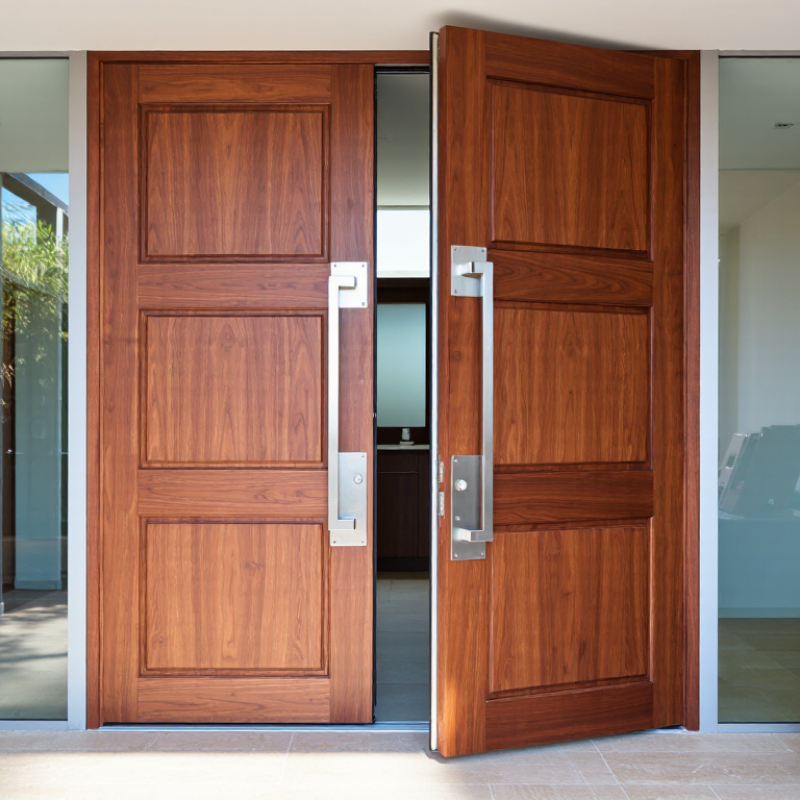
Chinese manufacturers commonly produce hinged, sliding, folding, pivot, and French-style double doors. Each format suits a different opening, not just a different look. Hinged pairs need clear swing space; sliding pairs save room but need a clean, aligned track. Folding leaves can open a wide patio, though their hinges and seals need careful adjustment. Pivot doors create a broad entrance, but their weight and floor support deserve early checking. Details matter. Common materials include engineered timber, aluminum, steel, uPVC, and glazed combinations. Specifications vary by project and supplier.
The Global Alliance for Buildings and Construction’s 2024 Global Status Report estimates that buildings and construction used 32% of global energy in 2023. The sector also contributed 34% of energy- and process-related carbon dioxide emissions. These figures make air leakage, glazing, and thermal breaks practical selection points, though a door alone cannot fix an inefficient building envelope. Ask manufacturers for measured thermal values, air-leakage results, hardware cycle tests, and installation tolerances—not just a thick-looking panel. Fit is unforgiving. A catalog number alone is not enough; installation often gets less attention than it deserves.
How Double Door Manufacturers Design and Produce Their Products
Double-door design begins with the opening, not a standard catalogue size. Engineers measure width, height, wall depth, floor level, and expected traffic. These details guide the frame, leaf thickness, hinge position, and threshold. A few millimeters can change how two leaves meet. Small gaps matter. The U.S. Department of Energy’s Energy Saver guidance estimates that air leakage can account for 25–40% of heating and cooling energy use in existing homes. This figure covers the whole home, not doors alone, but it shows why manufacturers check seals, meeting stiles, and frame fit. A heavier door is not automatically better; weight without reinforced hinges may create sagging.
Production usually moves from material selection to cutting, forming, assembly, finishing, and inspection. Depending on the design, factories may use steel, aluminum, timber, or composite panels. They check diagonal measurements to catch frame distortion, then inspect hinge alignment and the closing gap between leaves. A practical quality check includes repeated opening and closing, plus a review of lock engagement and weather seals. The IEA’s 2023 buildings analysis reports that buildings account for roughly 30% of global final energy consumption, making envelope performance an important design consideration. Still, factory checks cannot fully predict installation quality. Even a well-made pair can leak if the opening is uneven or the threshold is poorly fitted.
Key Criteria for Evaluating Chinese Double Door Manufacturers
What Is the Best Double Door Manufacturer in China?
Key Criteria for Evaluating Chinese Double Door Manufacturers
A strong manufacturer should explain how each door is built, not just quote a price. Ask for the core material, panel thickness, frame construction, finish type, and hardware specifications. For a sample, check whether both leaves meet evenly and the latch closes without force. Small gaps matter.
Request recent inspection records and confirm which tests apply to your door’s intended use. Check how the factory controls dimensions, surface finish, and hardware installation across larger orders. A polished sample proves little if production varies. Ask how defects are recorded and corrected, and whether packaging protects corners during shipment.
Look beyond the brochure. A factory visit, live video walkthrough, or detailed production photos can help verify equipment and workflow. Ask for realistic lead times, customization limits, and references for comparable projects. Clear answers are useful; vague promises deserve follow-up. Price matters, but so do replacement parts and after-sales response. No checklist is perfect. I would still compare a finished sample with the written specifications, because details can be missed on both sides.
What Is the Best Double Door Manufacturer in China?
Key criteria for evaluating Chinese double door manufacturers
Suggested evaluation weights for a buyer’s comparison checklist—not measured market data or ratings of individual manufacturers. Verify product specifications, test reports, certifications, customization capability, lead times, and after-sales terms for each supplier.
How to Select a Manufacturer for Your Project
When selecting a double door manufacturer in China, start with your project’s actual conditions: opening size, traffic, weather exposure, security needs, and finish. Ask for drawings showing frame depth, hinge positions, threshold height, and the meeting-seal detail. These small points affect installation and daily use. Fit matters.
Request test reports for the door configuration you plan to buy, not just a similar model. Check the tested size, glass or panel type, hardware, and performance ratings. Ask how the factory controls welding, coating thickness, dimensional tolerances, and final inspection. A certificate alone is not enough; confirm its scope and issuing laboratory. This check is not perfect, but it can expose gaps before production.
Delivery reliability also deserves scrutiny. The World Bank’s 2023 Logistics Performance Index placed China 19th among 139 economies, with a score of 3.7 out of 5. That national result offers context, not proof of one factory’s performance. Request recent production schedules, export packaging photos, and references for comparable projects. Clarify who pays for replacement parts if measurements are wrong. A polished catalogue can still leave unanswered questions. Ask them plainly.