2026 Top Types of Wedge Anchors Which One Is Best?
In 2026, choosing the best Wedge Anchors requires more than comparing diameter, price, or published load ratings. The right anchor must match the concrete condition, fixture, environment, and installation method. Cracked concrete changes the decision. So does a narrow edge distance.
Dr. Ronald A. Cook, a recognized researcher in anchorage to concrete, has stated, “The anchor is only one part of the load-transfer system.” That principle remains practical on real job sites. A stainless steel wedge anchor may suit a damp coastal location, while a zinc-plated model may fit a dry indoor application. The decision also depends on embedment depth, hole diameter, concrete strength, and applied torque. Small errors matter. Dust left inside a drilled hole can reduce reliability. Excessive tightening can damage threads or compromise the connection.
This guide compares the main types of Wedge Anchors used in construction, including carbon steel, stainless steel, hot-dip galvanized, and high-strength options. It examines their strengths, limitations, corrosion resistance, and typical applications. It also considers cracked and uncracked concrete, seismic demands, edge spacing, and inspection needs.
“Best” is rarely universal. That is the difficult part. A simple comparison table may look convincing, but it cannot replace project-specific engineering judgment. Even experienced installers can overlook substrate variation or inconsistent torque. For dependable results, select an anchor supported by recognized testing, follow the manufacturer’s installation instructions, and verify the connection before loading it.
Wedge Anchor Basics: Expansion Mechanics, Materials, and ASTM F1554 Grades
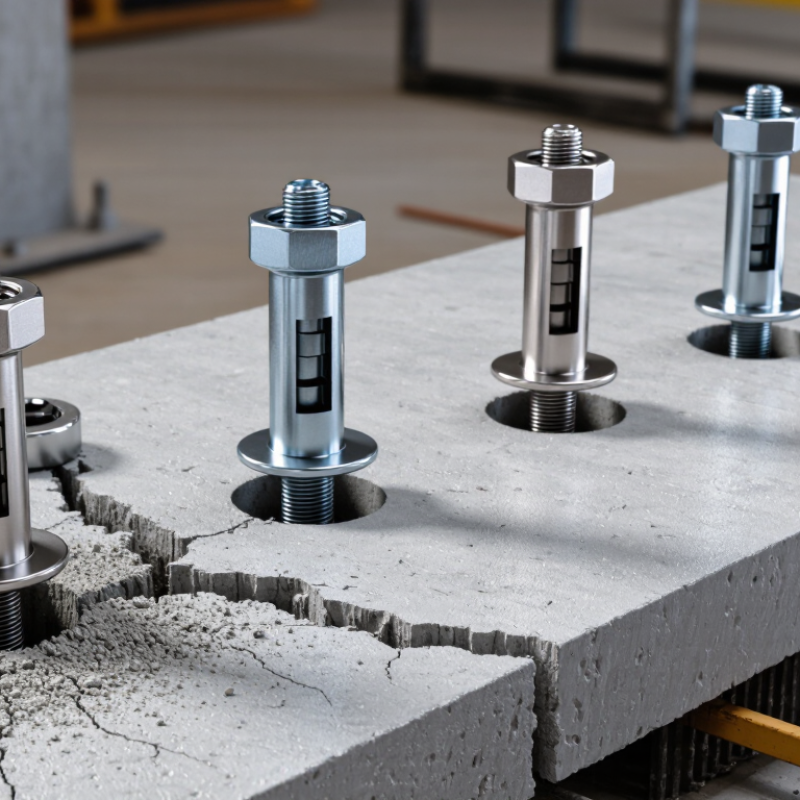
Wedge anchors secure fixtures by converting tightening torque into expansion. A threaded stud passes through a metal expansion clip inside a drilled concrete hole. As the nut tightens, the stud pulls upward, forcing the clip against the hole wall. The connection depends on hole diameter, embedment depth, concrete strength, and installation torque. A dusty or oversized hole can reduce holding power significantly. Standard, heavy-duty, galvanized, and stainless steel versions suit different loads and environments. Stainless steel usually performs better near moisture, while zinc-plated steel often suits dry indoor work.
ASTM F1554 grades describe anchor-rod material strength, not complete installation performance. Grade 36 provides a 36 ksi minimum yield strength, while Grades 55 and 105 provide higher yield levels. Higher strength is not automatically better. Concrete breakout, edge distance, and washer bearing may control the design first. In technical reviews, I would verify the actual material certificate and product testing rather than trust a grade printed on packaging. This detail is easy to miss.
Tips: Clean the hole with the specified brush and air sequence. Check embedment with a depth gauge. Use a calibrated torque wrench, and never guess the torque. Keep anchors away from unsupported edges unless the design allows it. Field conditions are rarely perfect, so record concrete cracks, hole depth, and installation torque before approving the connection.

Types of Wedge Anchors: Carbon Steel, Stainless Steel, and Hot-Dip Galvanized
Choosing the best wedge anchor depends on the concrete, load, and surrounding environment. Carbon steel anchors suit many dry indoor applications. They offer strong load performance and usually cost less. However, exposed carbon steel can rust when moisture reaches the threads or drilled hole.
Stainless steel wedge anchors provide better corrosion resistance in damp rooms, coastal areas, and food-processing spaces. They are also easier to maintain when appearance matters. Yet stainless steel does not automatically solve every problem. The concrete must still be sound, and the anchor needs correct embedment and installation torque. Salt changes everything.
Hot-dip galvanized wedge anchors create a thicker zinc coating than standard plated fasteners. They work well for outdoor framing, utility supports, and moderately corrosive environments. Inspect the coating after installation, especially where threads meet washers or nuts. A damaged area may become a starting point for corrosion. Dry interiors are different.
From field experience, a common mistake is choosing by price alone. I have seen low-cost anchors installed near concrete edges, where cracking reduced their holding capacity. Check the manufacturer’s tested load data, spacing, edge distance, and base-material condition. Clean the drilled hole carefully; dust can prevent proper expansion. I still question quick selections made without checking moisture, temperature, and future maintenance. A reliable choice matches the metal grade to the real site, not the ideal site.
How ICC-ES AC193 and ACI 318 Govern Wedge Anchor Performance
2026 Top Types of Wedge Anchors: Which One Is Best?
How ICC-ES AC193 and ACI 318 Govern Wedge Anchor Performance
The best wedge anchor is not chosen by diameter alone. Its performance depends on concrete strength, cracking, edge distance, and installation torque. ICC-ES AC193 evaluates mechanical anchors through tension and shear testing in cracked and uncracked concrete. It also examines displacement, sustained loading, and environmental conditioning. Published evaluation reports commonly show 5% fractile or lower-bound capacities, not average failure loads. These results expose weaknesses that a product brochure may hide.
ACI 318-19, Chapter 17, converts anchor test results into design strength. It checks concrete breakout, pullout, steel failure, pryout, and side-face blowout. The design must also account for spacing, edge distance, load direction, and cracked concrete. ASTM E488/E488M provides the common laboratory framework for tension and shear tests. An anchor passing a test is not automatically suitable for every job. I have seen installation errors erase theoretical capacity. The uncomfortable lesson is simple: torque, hole cleaning, and embedment deserve equal attention.
Tips: Select the anchor using evaluated project data, not habit. Verify the concrete condition before drilling. Use a calibrated torque wrench and record installation values. Check the evaluation report for spacing, temperature limits, and seismic provisions. If the report is unclear, pause and consult a qualified structural engineer. Small shortcuts can create large uncertainty.
Wedge Anchor Selection by Concrete Strength, Embedment, Load, and Corrosion Class
2026 Top Types of Wedge Anchors: Which One Is Best?
Wedge anchor selection starts with concrete strength, not catalog appearance. ACI 318-19 Chapter 17 separates cracked and uncracked concrete design. It also checks steel failure, pullout, concrete breakout, and splitting. A 25 MPa slab and a 40 MPa foundation cannot share one assumed capacity. Higher-strength concrete helps, but edge distance may control the result. Not automatically better.
Embedment must match the tested design range. EN 1992-4:2018 evaluates tension, shear, concrete cone failure, pryout, and load interaction. Deeper embedment can improve resistance, yet it may reduce performance near thin slabs or reinforcement. Select the anchor from verified evaluation data, then check spacing, edge distance, fixture holes, and installation torque. Field experience suggests that cleaning the hole is often underestimated. Dust remains a quiet failure risk.
Tips: Match the anchor type to the corrosion class. Zinc-plated steel suits controlled, dry interiors. Hot-dip galvanized or stainless steel may fit humid, exterior, or chloride-exposed areas. Confirm exposure using ISO 9223 principles and project specifications. For seismic or sustained tension, review ICC-ES AC193 or equivalent qualification reports. Measure twice. One practical weakness remains: drawings may specify embedment, but not actual concrete cracking or moisture conditions. Inspect those conditions before drilling.
2026 Top Types of Wedge Anchors: Which One Is Best?
Wedge anchor selection by concrete strength, embedment, load, and corrosion class
How to read this chart: The concrete classes and compressive strengths shown are standard EN 206 strength classes. Cylinder strength is the first value and cube strength is the second value, such as C30/37.
- Concrete strength: Higher-strength concrete can improve anchor resistance, but concrete cone failure, edge distance, spacing, and cracking conditions must still be checked.
- Embedment: Use the required effective embedment specified by the approved anchor design data. Greater embedment does not automatically increase capacity if other failure modes govern.
- Load: Check tension, shear, combined loading, seismic demand, installation torque, and the applied safety factors.
- Corrosion class: Zinc-plated anchors are generally intended for dry interior conditions; hot-dip galvanized or stainless-steel anchors are commonly selected for exterior, humid, or corrosive environments according to the project specification.
The best wedge anchor is the one that has approved performance data for the actual concrete condition, embedment depth, load case, installation method, and exposure environment.
Which Wedge Anchor Is Best in 2026? Comparing Safety, Durability, and Cost
Choosing the best wedge anchor in 2026 depends on safety, durability, and total cost. In reinforced concrete, zinc-plated carbon steel usually offers the lowest purchase price. It performs well indoors where moisture is limited. Hot-dip galvanized anchors provide better protection for outdoor applications. Stainless steel is often preferred near salt spray or persistent dampness. It costs more, but replacement work can cost much more.
The substrate matters just as much. Cracked concrete, thin slabs, weak concrete, and narrow edge distances can reduce holding strength. Not always. Safe installation requires the correct hole diameter, embedment depth, hole cleaning, and tightening torque. Concrete dust left inside the hole may prevent proper expansion. A torque wrench and a calibrated installation method improve consistency. Load tables and independent test documentation should guide selection, especially for overhead or vibration-prone fastening.
Price can mislead. A cheaper anchor may become expensive after corrosion, inspection failures, or early replacement. For a dry interior project, zinc-plated steel may be the practical choice. For exposed structures, galvanized steel often balances durability and cost. Stainless steel makes more sense in coastal or chemically aggressive environments. I would not choose stainless everywhere, because its added cost may bring little benefit indoors. I would also avoid treating one test result as universal; concrete quality and installation skill can change real performance. Always check current project requirements and the anchor’s verified technical data before installation.
2026 Top Types of Wedge Anchors: Which One Is Best?
Comparing safety, durability, corrosion resistance, installation conditions, and relative cost
| Wedge Anchor Type | Typical Material or Finish | Best Installation Environment | Safety and Load Behavior | Corrosion Resistance | Expected Service Durability | Relative Cost | Key Advantages | Main Limitations | Best Overall Use |
|---|---|---|---|---|---|---|---|---|---|
| Zinc-Plated Carbon Steel Wedge Anchor | Carbon steel body, nut, and washer with electroplated zinc coating | Dry, interior concrete applications with low exposure to moisture and chemicals | Provides reliable mechanical expansion when installed in sound, fully cured concrete at the specified embedment depth and torque | ★★☆☆☆ Limited protection in wet, exterior, or corrosive conditions | Good for protected indoor applications; service life decreases when the coating is damaged or continuously exposed to moisture | Low | Widely available, economical, and easy to install with standard tools | Not generally preferred for persistent outdoor exposure, marine locations, or chemically aggressive environments | Interior equipment, shelving, handrails, and light-to-moderate structural attachments in dry concrete |
| Mechanically Galvanized Wedge Anchor | Carbon steel with a thicker mechanically applied zinc coating | Moderately damp areas and some protected exterior applications, subject to the applicable product specification | Mechanical expansion performance is similar to other properly selected wedge anchors of the same diameter and embedment | ★★★☆☆ Better zinc protection than standard electroplating, but not equivalent to stainless steel in severe exposure | Suitable for many general construction environments when exposure is moderate and maintenance is possible | Low to medium | Improved coating thickness without the full cost of stainless steel | Coating damage, standing water, salt, and aggressive chemicals can still cause corrosion | General construction, sheltered outdoor attachments, and moderately humid concrete areas |
| Hot-Dip Galvanized Wedge Anchor | Carbon steel coated with a metallurgically bonded zinc layer by hot-dip galvanizing | Exterior concrete applications with regular weather exposure, where a zinc-coated fastener is permitted | Provides the same basic expansion principle as other wedge anchors; design capacity depends on diameter, embedment, concrete strength, edge distance, and spacing | ★★★★☆ Thicker zinc coating offers stronger atmospheric protection than standard zinc plating | Long service potential in outdoor environments when the coating remains intact and the exposure is not highly aggressive | Medium | Good balance between exterior durability and purchase cost | May not be the preferred choice for marine splash zones, severe chemical exposure, or applications requiring stainless compatibility | Outdoor steelwork, barriers, canopies, signs, and equipment supports in ordinary atmospheric conditions |
| Type 304 Stainless Steel Wedge Anchor | Austenitic 304 stainless steel components, where the complete assembly is specified accordingly | Interior or exterior areas with humidity, occasional wetting, and moderate atmospheric corrosion risk | Offers dependable expansion in sound concrete; the design must account for the lower strength of some stainless grades compared with high-strength carbon steel | ★★★★☆ Strong general corrosion resistance; less suitable for high-chloride or marine exposure than 316 stainless steel | Typically provides long-term performance in many architectural and outdoor environments when correctly selected | High | Good corrosion resistance, clean appearance, and reduced risk of red rust staining | Higher cost; stainless steel can gall during installation, so compatible nuts, proper torque, and suitable installation practice are important | Architectural metalwork, exterior fixtures, food-service areas, and damp locations with moderate corrosion exposure |
| Type 316 Stainless Steel Wedge Anchor | Molybdenum-bearing 316 stainless steel components, when specified as a complete anchor assembly | Coastal, marine-adjacent, high-humidity, and chloride-exposed environments | Provides mechanical anchorage in concrete, but final capacity must be based on published technical data for the exact anchor and installation condition | ★★★★★ Superior chloride and corrosion resistance among the common stainless options listed here | Very long service potential in severe outdoor environments when exposure, installation, and maintenance are properly controlled | Very high | Best corrosion resistance in this comparison and strong suitability for demanding exterior applications | Highest purchase cost; installation requires care to reduce galling, and it may be unnecessary for dry indoor work | Marine-adjacent structures, coastal facilities, wastewater areas, pools, and severe chloride environments |
| Seismic- or Cracked-Concrete-Qualified Wedge Anchor | Usually a specially tested carbon-steel or stainless-steel anchor system with documented qualification | Projects where cracked concrete, seismic tension, vibration, or qualification under a local design standard must be considered | May provide published performance data for cracked concrete or seismic design only when the exact anchor, diameter, embedment, and installation method are covered by the qualification | Depends on the selected steel grade and coating; qualification for cracked concrete does not automatically mean high corrosion resistance | Depends on material, exposure, inspection, and whether installation follows the qualified instructions | Medium to high | Can address demanding design conditions that ordinary wedge anchors may not cover | Not a universal anchor category; engineering documentation and project-specific installation requirements are essential | Safety-critical attachments, seismic regions, equipment supports, and designs involving cracked concrete |
Selection note: No single wedge anchor is best for every project. For dry interior concrete, zinc-plated carbon steel is usually the most economical option. For ordinary outdoor exposure, hot-dip galvanized steel often provides a practical balance. Type 304 stainless steel is suitable for many damp environments, while Type 316 stainless steel is generally the stronger choice for chloride-rich or marine conditions. Final anchor capacity must be verified using the exact product's published data, concrete strength, embedment depth, edge distance, spacing, load direction, and applicable building code or approval. Wedge anchors are intended for properly prepared concrete and should not be treated as a universal solution for brick, hollow block, or unverified masonry.